
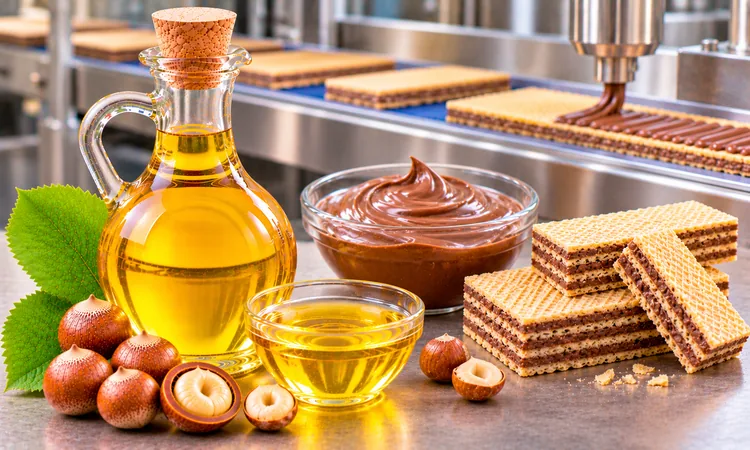
Overview. Industrial wafer cream fillings require controlled fat structure, consistent spreading and suitable stability after assembly. Refined hazelnut oil may be evaluated as a liquid oil ingredient in selected wafer cream formulations. Its effect depends on the existing fat system, solids content, manufacturing conditions and the complete wafer product.
Refined Hazelnut Oil in Wafer Cream Filling Formulations
Wafer creams commonly contain a combination of fats, sugars, flavor ingredients and other finely dispersed solids. The fat phase influences filling consistency, processing behavior and the finished product's texture.
Refined hazelnut oil is a liquid botanical oil containing predominantly unsaturated fatty acids, particularly oleic acid. It may be investigated as part of the liquid oil fraction in appropriate wafer cream formulations.
Its incorporation should be validated against the desired filling structure and long-term wafer crispness.
Potential Industrial Wafer Cream Applications
Manufacturers may investigate refined hazelnut oil in selected product concepts:
- Nut-flavored wafer creams: Evaluation of liquid oil content, flavor balance and filling consistency.
- Chocolate-style wafer fillings: Assessment of oil-phase compatibility with suitable cocoa and fat systems.
- Multi-layer wafer products: Investigation of cream spreading and structural stability after assembly.
- Industrial confectionery fillings: Controlled testing of viscosity, processing and oil migration.
Fat-Phase Balance and Crystallization
Wafer cream structure often depends on the crystallization behavior of solid and semi-solid fat components.
Adding liquid refined hazelnut oil can alter the solid-fat fraction and the overall crystal network. This may change filling firmness, spreadability and oil retention.
Manufacturers should evaluate the existing fat system before replacing any portion with liquid oil.
A direct substitution for a hard confectionery fat is not necessarily suitable without reformulation.
Filling Viscosity and Spreadability
Industrial wafer production requires controlled cream flow and consistent distribution between wafer sheets.
Filling viscosity may be influenced by fat content, temperature, sugar particle size and other dispersed ingredients.
Refined hazelnut oil may influence flow behavior, but the effect depends on the complete formulation.
Manufacturers should measure viscosity under representative processing temperatures and shear conditions.
Particle-Size Distribution and Mouthfeel
Finely dispersed sugar, cocoa and other solids affect cream texture and spreadability.
Particle-size distribution influences mouthfeel and interactions within the fat phase.
Grinding and mixing conditions should remain consistent during trials so the effect of an oil-phase change can be evaluated accurately.
Oil Migration into Wafer Sheets
Liquid oil can migrate from the cream filling into adjacent wafer layers.
Excessive oil migration may cause visible staining, texture changes or reduced crispness.
The extent of migration depends on oil concentration, fat structure, wafer characteristics and storage conditions.
Manufacturers should evaluate the assembled wafer product, not just the isolated cream filling.
Wafer Crispness and Moisture Control
Wafer crispness depends on the properties of the baked wafer sheets and the surrounding product environment.
Moisture migration, humidity and packaging barrier performance can strongly influence texture during storage.
Oil migration should be evaluated separately from moisture-related loss of crispness.
Suitable packaging and controlled storage conditions are important for the complete wafer product.
Mixing, Cooling and Assembly Conditions
Cream preparation may involve fat melting, blending, mixing, temperature control and deposition onto wafer sheets.
Cooling conditions can influence fat crystallization and the final firmness of the filling.
Manufacturers should document processing temperature, mixing conditions, filling application rate and cooling profile.
These variables should be controlled during pilot-scale comparisons.
Oxidative Stability and Flavor Quality
Unsaturated oils may undergo oxidation during unsuitable storage conditions.
Refined hazelnut oil should be assessed within the total lipid system, including other fats and ingredients.
Relevant evaluations may include peroxide value, other oxidation indicators, aroma, taste and color changes.
The finished product's shelf life must be established through representative storage testing.
Recommended Wafer Cream Development Tests
A controlled trial program should compare the reference filling with selected experimental oil concentrations.
Relevant tests include:
- Filling viscosity and spreading consistency.
- Fat crystallization and filling firmness.
- Particle-size distribution and mouthfeel.
- Oil separation and visible oil migration.
- Wafer crispness after assembly.
- Moisture migration and humidity stability.
- Oxidation indicators and sensory quality.
- Packaging performance and finished-product shelf life.
Pilot-scale results should be confirmed on the intended production equipment before commercial adoption.
Refined Hazelnut Oil Technical Specifications
Consistent incoming raw-material quality supports repeatable confectionery formulation. The stated refined hazelnut oil parameters include:
- Free fatty acids (FFA): Maximum 0.3%.
- Moisture content: Maximum 0.2%.
- Oleic acid: 74.2–86.7%.
These figures describe stated raw-material acceptance parameters and do not guarantee wafer filling stability, crispness retention or shelf-life performance.
Additional quality testing may be required according to the manufacturer's purchasing specification.
Review the refined hazelnut oil technical specifications and confirm current available batch documentation.
Food Safety and Allergen Management
Hazelnut is a tree nut and should be considered under applicable allergen labeling requirements.
Wafer products may also contain wheat, milk, soy or other allergens, depending on their ingredients.
Manufacturers should maintain suitable sanitation, cross-contact prevention, traceability and ingredient declaration procedures.
Bulk Refined Hazelnut Oil for Wafer Manufacturers
Atlas Global Trading supplies refined hazelnut oil to international industrial and wholesale ingredient buyers, including wafer and confectionery manufacturers evaluating liquid oil ingredients.
Commercial packaging formats include:
- 30 kg plastic drums: Smaller industrial purchasing quantities.
- 60 kg plastic drums: Intermediate bulk ingredient orders.
- 200 kg plastic drums: Larger-volume confectionery manufacturing procurement.
- Larger export and tanker formats: Subject to commercial volume and logistics feasibility.
Atlas Global Trading supplies refined hazelnut oil as a bulk raw material, not finished wafer creams or ready-to-sell confectionery.
Commercial Purchasing and Supply Planning
Professional buyers should define their intended wafer cream application, expected consumption, required oil specifications, packaging preference and delivery destination.
Commercial discussions may cover current product documentation, batch traceability, packaging, international shipment arrangements and applicable trade terms.
Buyers remain responsible for validating finished-product performance and compliance with destination-market requirements.
Share your intended wafer cream application, expected purchasing volume, preferred packaging, delivery destination and technical documentation requirements. Our team will review your inquiry and discuss available international bulk supply options.