
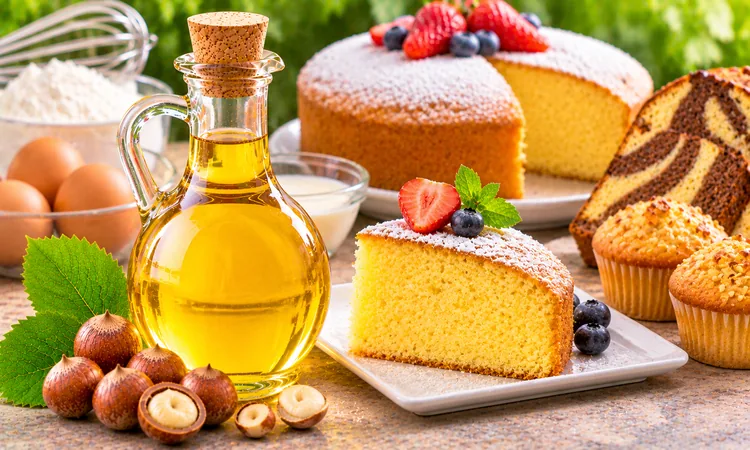
Overview. Industrial cake and sponge production requires controlled batter structure, air incorporation, fat dispersion and repeatable baking performance. Refined hazelnut oil may be evaluated as a liquid fat component in selected cake formulations. Its effect depends on the emulsifier system, mixing method, complete recipe and finished-product quality requirements.
Refined Hazelnut Oil in Industrial Cake Formulations
Fat influences cake tenderness, batter consistency, sensory properties and overall product structure.
Refined hazelnut oil contains predominantly unsaturated fatty acids, particularly oleic acid, and may be investigated as part of the liquid fat phase in suitable cake and sponge product formulations.
It should be evaluated within the actual recipe because liquid oils behave differently from structured bakery fats.
Potential Cake and Sponge Applications
Industrial bakeries may evaluate refined hazelnut oil in selected product concepts:
- Oil-based cake batters: Assessment of fat incorporation, mixing and finished crumb texture.
- Sponge-style products: Controlled evaluation of batter aeration and volume.
- Layer cakes: Investigation of crumb tenderness and storage softness.
- Industrial cake mixes: Evaluation of compatibility with suitable emulsifier and ingredient systems.
Each formulation should be validated before commercial manufacturing.
Liquid Oils Versus Solid Bakery Fats
Refined hazelnut oil is liquid at typical handling temperatures and does not contribute the same crystalline fat structure as solid shortening.
In traditional creaming processes, solid fat can contribute to air incorporation during mixing.
Replacing such fats with liquid oil may change batter aeration and finished-product volume.
Alternative mixing methods or emulsifier adjustments may be required.
Batter Emulsification and Fat Dispersion
Cake batters typically combine water-containing ingredients with fats, flour, sugar and other components.
Emulsifier systems can influence fat dispersion and the stability of incorporated air.
The effectiveness of the emulsifier depends on its chemistry, concentration, ingredient interactions and processing conditions.
Manufacturers should verify that refined hazelnut oil is compatible with the complete batter system.
Mixing Method and Ingredient Addition Sequence
Mixing speed, duration, ingredient order and batter temperature can affect the finished product.
Liquid oil may require a different incorporation approach from solid fats used in conventional creaming methods.
Process trials should document mixing conditions and compare batter consistency and aeration against the reference recipe.
Cake Batter Aeration and Specific Gravity
Air incorporation contributes to cake expansion and crumb structure.
Batter specific gravity can provide an indication of air incorporation when measured under consistent conditions.
Changes in oil type or concentration may influence air bubble stability and the distribution of gas cells during baking.
Manufacturers should compare batter density, air incorporation and finished cake volume.
Crumb Structure and Product Volume
Cake quality depends on suitable expansion and setting of the crumb structure.
Liquid oil incorporation may influence cell distribution, crumb openness and tenderness.
Product developers should evaluate cake height, specific volume, crumb appearance and texture.
These measurements help determine whether the experimental fat system meets the target product profile.
Crumb Softness and Storage Stability
Cake texture changes during storage as moisture redistributes and structural changes take place.
The oil phase may influence the sensory perception of softness, but it does not independently determine finished-product shelf life.
Manufacturers should evaluate texture, moisture distribution, flavor and sensory properties throughout the intended storage period.
Flavor, Oxidation and Packaging
Refined hazelnut oil contains unsaturated fatty acids that may oxidize under unfavorable conditions.
The finished cake's oxidation behavior depends on the complete formulation, baking, packaging and storage.
Relevant evaluations may include sensory changes, flavor stability and appropriate oxidation indicators.
Packaging should also be assessed for moisture retention, oxygen exposure and compatibility with the finished product.
Recommended Cake and Sponge Formulation Tests
Controlled development trials should compare the reference fat system with selected refined hazelnut oil concentrations.
Relevant evaluations include:
- Batter viscosity and mixing consistency.
- Batter specific gravity and air incorporation.
- Emulsion stability and fat dispersion.
- Cake volume and baked-product height.
- Crumb cell distribution and openness.
- Texture, tenderness and softness during storage.
- Moisture, sensory quality and oxidation stability.
- Packaging compatibility and finished-product shelf life.
Pilot-scale results should be confirmed using representative industrial production equipment and baking conditions.
Refined Hazelnut Oil Technical Specifications
Consistent incoming raw-material quality supports repeatable industrial cake production. The stated refined hazelnut oil parameters include:
- Free fatty acids (FFA): Maximum 0.3%.
- Moisture content: Maximum 0.2%.
- Oleic acid: 74.2–86.7%.
These figures describe stated raw-material acceptance parameters and do not guarantee batter aeration, crumb texture or finished-product shelf-life performance.
Additional batch qualification may be required according to the manufacturer's purchasing specifications.
Review the refined hazelnut oil technical specifications and confirm current available batch documentation.
Food Safety and Allergen Management
Hazelnut is a tree nut and must be considered under applicable food allergen labeling requirements.
Cake and sponge products may also contain wheat, egg, milk or other allergens, depending on the recipe.
Manufacturers should maintain suitable ingredient traceability, sanitation, cross-contact prevention and finished-product labeling procedures.
Bulk Refined Hazelnut Oil for Industrial Bakeries
Atlas Global Trading supplies refined hazelnut oil to international industrial and wholesale ingredient buyers, including cake and sponge manufacturers evaluating suitable liquid fat ingredients.
Commercial packaging formats include:
- 30 kg plastic drums: Smaller industrial purchasing quantities.
- 60 kg plastic drums: Intermediate bulk ingredient orders.
- 200 kg plastic drums: Larger-volume industrial bakery procurement.
- Larger export and tanker formats: Subject to commercial volume and logistics feasibility.
Atlas Global Trading supplies refined hazelnut oil as a bulk raw material, not finished cakes, sponge products or ready-to-sell bakery items.
Commercial Procurement and Supply Planning
Industrial buyers should identify their intended cake formulation, required oil specifications, anticipated consumption, packaging preference and delivery destination.
Commercial discussions may include current batch documentation, raw-material qualification, packaging, storage arrangements, international shipment and relevant trade terms.
Buyers remain responsible for finished-product qualification and compliance with applicable food regulations.
Share your intended cake or sponge application, expected purchasing volume, preferred packaging, delivery destination and technical documentation requirements. Our team will review your inquiry and discuss available international bulk supply options.