
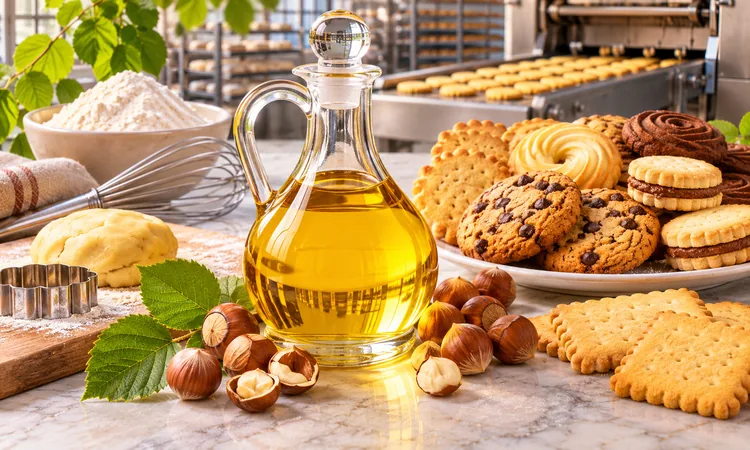
Overview. Fats and oils are important ingredients in biscuit and cookie manufacturing, influencing dough consistency, product spread, texture and sensory characteristics. Refined hazelnut oil may be evaluated as a liquid vegetable oil component in selected industrial bakery formulations, particularly where the desired product structure is compatible with a liquid fat ingredient.
Refined Hazelnut Oil in Industrial Biscuit and Cookie Formulations
Biscuit and cookie manufacturing relies on the interaction between flour, sugar, fats, moisture and other functional ingredients.
The selected fat system influences dough lubrication, mixing behavior, product spread and finished texture.
Refined hazelnut oil contains predominantly unsaturated fatty acids, particularly oleic acid, and may be investigated as a partial component of the fat phase in suitable bakery formulations.
Because it is predominantly liquid at typical handling temperatures, its behavior differs from that of solid bakery shortenings, butter or structured fats.
Any substitution should therefore be assessed against the intended processing and finished product requirements.
Potential Biscuit and Cookie Applications
Refined hazelnut oil may be evaluated in selected industrial biscuit and cookie systems.
- Soft cookie formulations: Evaluation as part of the liquid fat phase, subject to the required texture and spread.
- Crisp biscuits: Investigation of fat balance and its influence on fracture characteristics.
- Specialty bakery products: Use in selected recipes requiring a liquid vegetable oil component.
- Reformulated fat systems: Controlled trials involving partial replacement of another compatible bakery fat or oil.
The actual result depends on the complete formula, mixing procedure and baking conditions.
Liquid Oil Versus Solid Shortening
Solid shortenings can provide crystalline fat structure and contribute to air incorporation during certain mixing methods.
Liquid oils generally do not reproduce this functionality directly, which can influence the finished cookie's structure and texture.
Important considerations include:
- Creaming performance: Liquid oil may behave differently from solid fat during sugar-fat mixing and aeration.
- Dough consistency: A change in liquid fat content can alter dough handling.
- Cookie spread: Fat structure affects how dough flows during baking.
- Finished texture: The balance of crispness, tenderness and fracture characteristics may change.
Direct weight-for-weight replacement of a solid fat with refined hazelnut oil is not automatically appropriate.
Dough Mixing and Processing Behavior
Industrial mixing conditions influence ingredient distribution, dough development and processing consistency.
When introducing refined hazelnut oil, manufacturers should review the oil addition sequence, mixing time, dough temperature and hydration balance.
Depending on the original formulation, liquid oil may affect dough cohesion, flow and shaping behavior.
Production trials should assess whether the modified dough can be processed consistently through depositing, rotary molding, cutting or other applicable forming equipment.
Cookie Spread, Dimensions and Baking Performance
Cookie spread is a significant quality parameter for many industrial bakery products.
The relationship between liquid fat, sugar, flour, moisture and dough temperature can affect cookie expansion during baking.
Manufacturers should evaluate:
- Cookie diameter and thickness.
- Spread ratio and shape consistency.
- Surface appearance and color.
- Baking time and temperature.
- Finished moisture and water activity.
- Product weight and dimensional variation.
Pilot bakes should be performed under controlled conditions to establish whether changes are attributable to the selected oil or other process variables.
Texture, Fracture and Sensory Properties
The fat phase contributes to biscuit tenderness, cookie crispness and eating quality.
Adjusting the liquid oil fraction may influence the mechanical properties of the finished product.
Important testing parameters include breaking force, fracture behavior, perceived crispness and sensory characteristics.
The interaction of the selected oil with flour, sugar and other ingredients should be assessed in the complete baked product.
Industrial Baking and Production Controls
Commercial biscuit and cookie manufacturing requires repeatable production controls from ingredient dosing to finished packaging.
Relevant process variables include:
- Accurate weighing and oil dosing.
- Mixing sequence, time and speed.
- Dough temperature and consistency.
- Forming and depositing accuracy.
- Oven temperature and residence time.
- Cooling conditions before packaging.
- Equipment hygiene, allergen controls and batch traceability.
Formulation changes should be validated under realistic commercial production conditions before full-scale implementation.
Oil Migration and Product Surface Quality
The amount and mobility of oil within a biscuit or cookie can influence the product's surface characteristics and packaging behavior.
In some formulations, an excessive liquid oil fraction may increase the risk of surface oil or migration during storage.
Manufacturers should assess product appearance, packaging contact and changes in texture under expected storage conditions.
Oxidation Stability and Shelf-Life Evaluation
Refined hazelnut oil contains unsaturated fatty acids that can undergo oxidation during unfavorable storage or processing.
Oxidation may influence aroma, flavor and finished-product acceptability.
Relevant assessments may include:
- Peroxide value and other suitable oxidation indicators.
- Flavor and odor changes.
- Moisture and water activity.
- Texture changes during storage.
- Surface oil and migration.
- Packaging barrier properties and seal integrity.
Shelf-life studies should reflect the actual product formulation, packaging and intended distribution environment.
The stated properties of the raw oil do not guarantee a particular shelf life for the finished biscuit or cookie.
Refined Hazelnut Oil Technical Specifications
Consistent raw-material quality supports industrial bakery manufacturing and controlled formulation development.
The stated quality parameters of the supplied refined hazelnut oil include:
| Quality Parameter | Stated Value |
|---|---|
| Free Fatty Acids (FFA) | Maximum 0.3% |
| Moisture Content | Maximum 0.2% |
| Oleic Acid | 74.2–86.7% |
These figures are stated raw-material acceptance values rather than guaranteed baking performance or finished-product characteristics.
Manufacturers should review additional quality requirements according to their intended application and purchasing specification.
Consult the refined hazelnut oil technical specifications page and confirm current available batch documentation.
Recommended Biscuit and Cookie Formulation Trials
Manufacturers should start with a validated reference recipe and introduce controlled changes to the fat system.
Pilot batches may compare several refined hazelnut oil inclusion levels, mixing conditions and baking parameters.
Measurements should include dough consistency, cookie dimensions, spread ratio, breaking force, sensory quality and packaged texture during storage.
The preferred formulation should be validated at commercial production scale.
Bulk Refined Hazelnut Oil for Biscuit Manufacturers
Atlas Global Trading supplies refined hazelnut oil for international industrial and wholesale buyers, including manufacturers evaluating specialty edible oils for biscuit and cookie formulations.
Commercial packaging options include:
- 30 kg plastic drums: A smaller industrial purchasing format.
- 60 kg plastic drums: An intermediate commercial supply option.
- 200 kg plastic drums: Suitable for larger-volume ingredient requirements.
- Larger export and tanker formats: Considered according to commercial volume, receiving arrangements and logistics feasibility.
Buyers should confirm order quantity, packaging preference, destination country, current specifications and technical documentation requirements before purchasing.
Commercial Purchasing and Supply Planning
Industrial bakery procurement teams should consider production schedules, forecast oil consumption, available storage capacity and receiving arrangements.
Commercial discussions may address current specifications, batch traceability, available documents, shipment requirements, delivery planning and relevant trade terms.
Manufacturers should validate the intended formulation before committing to large-scale production purchases.
Allergen Management and Food Labeling
Hazelnut is a tree nut and is subject to allergen labeling requirements in many food markets.
Manufacturers should review ingredient declarations, cross-contact controls and cleaning procedures before introducing refined hazelnut oil into their production facilities.
The finished biscuit or cookie must comply with applicable food safety, composition and labeling requirements.
Why Source from Atlas Global Trading?
Atlas Global Trading focuses on international bulk refined hazelnut oil supply for professional industrial and wholesale ingredient buyers.
Our commercial approach emphasizes clear product information, practical bulk packaging options and purchasing discussions based on customer requirements.
Share your expected order volume, preferred packaging, delivery destination, biscuit or cookie application and technical documentation requirements. Our team will review the inquiry and discuss available commercial options. Finished-product formulation, food safety and regulatory compliance remain the manufacturer's responsibility.