
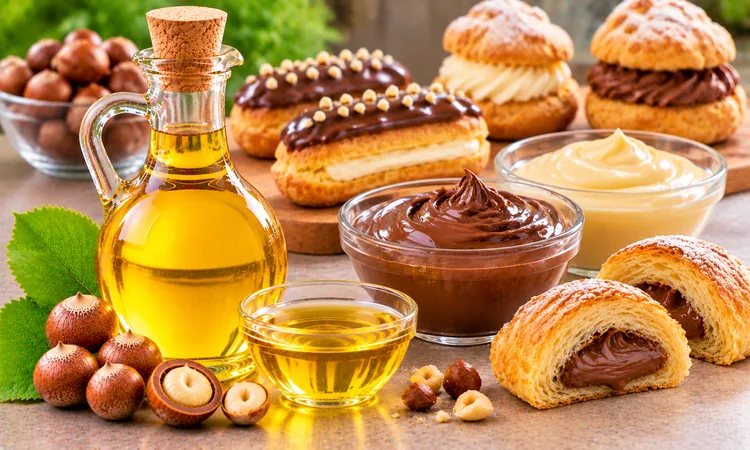
Overview. Industrial pastry fillings require a balance of texture, flow characteristics, flavor and stability. Refined hazelnut oil may be evaluated as a liquid vegetable oil ingredient in selected fat-based bakery fillings. Its inclusion can influence spreadability, viscosity and mouthfeel, although performance depends on the complete formulation and processing conditions.
The Role of Refined Hazelnut Oil in Pastry Fillings
Fat-based pastry fillings commonly combine oils or fats with sugar, cocoa, nut solids, emulsifiers and other functional ingredients. The fat phase influences consistency, lubrication, particle suspension and the product's behavior during depositing.
Refined hazelnut oil contains predominantly unsaturated fatty acids, particularly oleic acid. As a liquid oil, it may be investigated for adjusting the flow properties of compatible pastry fillings.
Unlike solid bakery shortenings, refined hazelnut oil does not create the same crystalline fat network. Its use should therefore be assessed alongside any structured fats and stabilizing ingredients.
Potential Industrial Bakery Applications
Manufacturers may evaluate refined hazelnut oil in selected applications, including:
- Nut-based pastry fillings: Adjusting the liquid fat fraction and evaluating spreadability and oil separation.
- Cocoa and confectionery fillings: Assessing viscosity, particle suspension and compatibility with existing fat systems.
- Sandwich and layered pastry creams: Testing deposit consistency, texture and storage stability.
- Post-bake fillings: Evaluating pumping, injection and finished-product mouthfeel.
Application suitability depends on whether the filling is baked, injected after baking, chilled or stored at ambient temperature.
Fat-Phase Balance and Filling Texture
The ratio of liquid oil to solid fat is a major factor in the texture of fat-based fillings. Increasing the liquid oil content may reduce firmness or change flow behavior, but excessive oil can weaken the filling structure.
Sugar and cocoa particle size, solids loading, emulsifier selection and processing temperature also influence viscosity and final consistency.
Manufacturers should establish target characteristics for spreading, depositing and product firmness before changing the oil phase.
Oil Separation and Product Stability
Fat-based fillings can exhibit oil migration or surface oil separation when the liquid lipid fraction is not adequately retained by the formulation.
Relevant factors include the crystalline fat network, particle interactions, mixing conditions, storage temperature and total oil concentration.
Filling stability should be evaluated both as a standalone ingredient system and within the finished bakery product. Migration into pastry layers may change texture and appearance during storage.
Pumpability, Depositing and Filling Performance
Industrial filling systems require predictable flow through transfer equipment, pumps and depositing nozzles. Refined hazelnut oil may influence the rheology of suitable formulations, but the effect must be measured.
Production trials should evaluate viscosity at actual processing temperatures, pumping behavior, nozzle performance, deposit accuracy and filling consistency.
Changes that improve pumpability may also affect the filling's ability to retain its shape after depositing. Both operating efficiency and finished-product structure should be considered.
Baking, Chilling and Temperature Stability
Pastry fillings experience different thermal conditions depending on the manufacturing process. Bake-in fillings may be exposed to elevated temperatures, while post-bake fillings may require stable texture during cooling and storage.
Manufacturers should monitor oil migration, filling leakage, consistency changes and sensory properties under conditions representative of the finished product.
Refined hazelnut oil is not automatically a substitute for heat-stable structured fats. Bake stability must be established through product-specific testing.
Industrial Mixing and Manufacturing Controls
Commercial production should maintain accurate ingredient dosing and consistent processing conditions. Important controls include:
- Verification of raw-material identity and quality.
- Accurate weighing of oil, fats and dry ingredients.
- Controlled mixing sequence and temperature.
- Particle distribution and filling uniformity.
- Viscosity and depositing performance.
- Hygienic handling and allergen cross-contact controls.
- Batch identification and traceability.
Laboratory and pilot-scale results should be confirmed under representative commercial manufacturing conditions.
Recommended Pastry Filling Quality Tests
Product development should compare a reference filling with controlled changes to the oil fraction. Relevant evaluations may include:
- Viscosity and flow behavior at processing temperature.
- Oil separation and storage stability.
- Pumpability and deposit accuracy.
- Texture, firmness and spreadability.
- Filling performance after baking or chilling.
- Fat migration into pastry or biscuit layers.
- Flavor, aroma and oxidation stability.
- Finished-product food safety and shelf-life testing.
Water-containing pastry creams require suitable microbiological controls and an appropriately validated preservation or thermal-processing strategy. Adding oil does not establish microbiological shelf stability.
Refined Hazelnut Oil Technical Specifications
Incoming raw-material consistency supports controlled formulation and repeatable production. The stated refined hazelnut oil parameters include:
| Quality Parameter | Stated Value |
|---|---|
| Free Fatty Acids (FFA) | Maximum 0.3% |
| Moisture Content | Maximum 0.2% |
| Oleic Acid | 74.2–86.7% |
These values describe stated raw-material acceptance parameters. They do not guarantee filling stability, baking performance or finished-product shelf life.
Buyers should confirm additional quality parameters and available batch documentation according to their purchasing requirements.
Review the refined hazelnut oil technical specifications before commercial procurement.
Food Safety and Allergen Management
Hazelnut is a tree nut and must be considered under applicable food allergen requirements. Manufacturers should evaluate ingredient labeling, cross-contact prevention, cleaning procedures and destination-market regulations.
Pastry fillings may contain additional allergens, including milk, soy, wheat or other nuts, depending on the recipe. Refining alone does not establish an exemption from allergen assessment.
Bulk Refined Hazelnut Oil for Bakery Manufacturers
Atlas Global Trading supplies refined hazelnut oil for industrial and wholesale ingredient buyers evaluating liquid vegetable oils for pastry fillings and other bakery formulations.
Commercial packaging formats include:
- 30 kg plastic drums: Smaller industrial purchasing quantities.
- 60 kg plastic drums: Intermediate bulk supply requirements.
- 200 kg plastic drums: Larger-volume industrial ingredient purchasing.
- Larger export and tanker formats: Subject to order volume, destination and logistics feasibility.
Atlas Global Trading supplies refined hazelnut oil as a bulk raw material, not finished pastry fillings, ready-to-use creams or retail bakery products.
Commercial Procurement and Supply Planning
Professional buyers should confirm their intended filling application, forecast consumption, packaging preference, destination and receiving arrangements.
Commercial discussions may include current specifications, available quality documentation, batch traceability, shipping arrangements and applicable trade terms. Final ingredient qualification and finished-product compliance remain the manufacturer's responsibility.
Share your purchasing volume, preferred packaging, delivery destination, pastry filling application and technical documentation requirements. Our team will review your inquiry and discuss available supply options.