
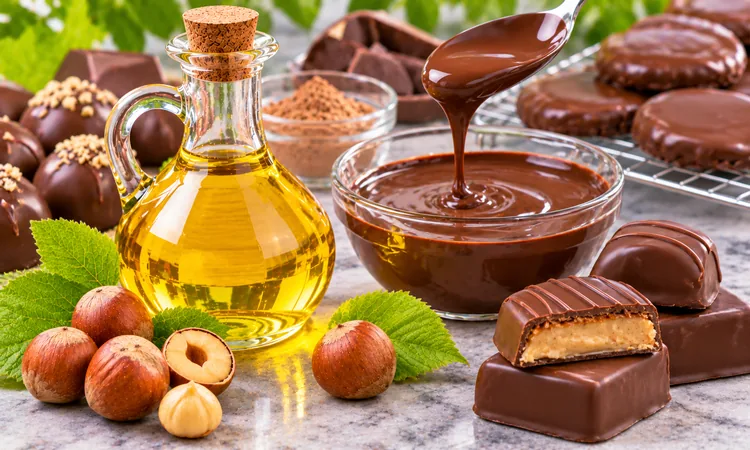
Overview. Chocolate and compound coatings require carefully controlled fat systems to achieve the desired viscosity, setting behavior, appearance and texture. Refined hazelnut oil may be investigated as a minor liquid lipid component in selected experimental coating formulations. However, its predominantly liquid properties differ from those of structured confectionery fats, making compatibility and stability testing essential.
Refined Hazelnut Oil in Confectionery Coating Research
Chocolate and compound coatings commonly contain sugar, cocoa ingredients, emulsifiers and a carefully selected fat phase.
The fat system is responsible for important processing and finished-product properties, including flow, crystallization, melting characteristics and coating firmness.
Refined hazelnut oil contains predominantly unsaturated fatty acids, particularly oleic acid, and may be evaluated as a supplementary liquid oil ingredient in compatible formulations.
Its incorporation requires careful assessment because even relatively small changes to the fat phase can affect the behavior of a confectionery coating.
Chocolate Versus Compound Coating Fat Systems
Chocolate and compound coatings use different fat system approaches and may have different processing requirements.
- Chocolate formulations: Cocoa butter crystallization is important for the desired setting, gloss, snap and melting characteristics.
- Compound coatings: Alternative vegetable fat systems may be used, with functionality depending on the selected fat composition and processing method.
- Experimental fat blends: Minor quantities of liquid oil may be screened for their effects on rheology and sensory properties.
Refined hazelnut oil is not a direct structural substitute for cocoa butter or specialized compound coating fats.
Chocolate composition and product naming must also comply with applicable destination-market regulations.
Cocoa Butter Compatibility and Fat Crystallization
Cocoa butter has specific crystallization behavior that influences the physical properties of chocolate products.
Changes in the composition of the fat phase may affect crystal formation, firmness and the stability of the finished coating.
Introducing liquid refined hazelnut oil may alter the proportion of solid fat present at a particular temperature.
Important technical evaluations include:
- Fat compatibility: Behavior of refined hazelnut oil with cocoa butter or alternative coating fats.
- Solid fat content: The proportion of crystallized fat at relevant temperatures.
- Crystallization behavior: Changes in setting and fat structure.
- Melting profile: The influence of fat composition on thermal and sensory properties.
- Storage stability: Changes in physical appearance and fat structure over time.
Compatibility must be demonstrated experimentally rather than assumed from the oil's fatty acid profile.
Coating Viscosity, Yield Stress and Processing
Industrial coating applications require controlled flow characteristics to support uniform deposition and consistent coating thickness.
Liquid oil incorporation may influence viscosity and yield stress depending on the total fat content, dispersed solids and emulsifier system.
Relevant production operations may include:
- Enrobing and coating of bakery or confectionery products.
- Depositing of selected coating formulations.
- Molding or controlled filling, where compatible with the fat system.
- Mixing and transfer through industrial processing equipment.
Formulators should assess coating behavior at the intended processing temperature and verify whether the product sets to the required structure.
Setting Time, Gloss and Snap
Setting behavior influences production throughput, handling and the appearance of finished confectionery coatings.
The selected fat system may affect coating firmness, surface gloss and mechanical fracture characteristics.
An increase in mobile liquid oil may soften some formulations or alter the expected snap and setting behavior.
These effects should be assessed through controlled trials under representative processing and cooling conditions.
Fat Bloom and Coating Stability
Fat bloom is an important quality concern in chocolate and some related confectionery coatings.
It may appear as a whitish or dull surface change associated with changes in fat distribution or crystallization.
Formulation changes that alter fat compatibility or oil mobility can influence bloom behavior.
Manufacturers should investigate the relationship between oil concentration, fat crystallization, temperature variation and finished-product appearance.
Storage trials should include conditions representative of the intended distribution and retail environment.
Industrial Processing and Production Controls
Chocolate-related coating manufacturing may involve ingredient mixing, refining, temperature control, tempering where appropriate, coating application and cooling.
Relevant process variables include:
- Accurate ingredient weighing and liquid oil dosing.
- Mixing conditions and batch consistency.
- Particle-size distribution and dispersed solid content.
- Processing and application temperature.
- Tempering or cooling conditions where applicable.
- Coating thickness, setting time and product handling.
- Allergen cross-contact controls and equipment hygiene.
Experimental formulations should be compared with an established reference coating under consistent manufacturing conditions.
Oxidation and Shelf-Life Evaluation
The unsaturated fatty acids present in refined hazelnut oil may undergo oxidation during unfavorable processing or storage.
Oxidative changes can affect aroma, flavor and overall product acceptability.
Relevant stability testing may include:
- Peroxide value and other appropriate oxidation indicators.
- Flavor and aroma changes.
- Fat bloom and changes in surface appearance.
- Coating firmness, snap and melting characteristics.
- Packaging compatibility and barrier performance.
- Finished-product behavior under expected storage conditions.
The final shelf life must be established through testing of the complete coating formulation.
Refined Hazelnut Oil Technical Specifications
Raw-material consistency is important when conducting fat compatibility studies and developing industrial confectionery formulations.
The stated quality parameters of the supplied refined hazelnut oil include:
| Quality Parameter | Stated Value |
|---|---|
| Free Fatty Acids (FFA) | Maximum 0.3% |
| Moisture Content | Maximum 0.2% |
| Oleic Acid | 74.2–86.7% |
These values describe stated raw-material acceptance parameters. They do not establish cocoa butter compatibility, bloom resistance, coating performance or commercial shelf life.
Additional quality testing may be required according to customer specifications and the intended application.
Review the refined hazelnut oil technical specifications and confirm available current batch documentation.
Recommended Coating Formulation Trials
Confectionery manufacturers should begin with an established reference formulation and introduce controlled changes to the liquid oil fraction.
Pilot trials should compare selected refined hazelnut oil inclusion levels while maintaining consistent processing conditions.
Relevant measurements include viscosity, yield stress, setting time, crystallization behavior, melting profile, gloss, snap and fat bloom during storage.
Commercial-scale evaluation should follow only after acceptable performance has been demonstrated in formulation trials.
Chocolate Labeling and Regulatory Considerations
The use of vegetable oils in products marketed as chocolate may be subject to specific compositional and labeling requirements.
Manufacturers should distinguish between products legally classified as chocolate and products sold as compound or confectionery coatings.
In some markets, the type and quantity of vegetable fat that may be used in chocolate are restricted.
Refined hazelnut oil should not be assumed to qualify as an authorized cocoa butter equivalent or permitted alternative fat.
Final product composition, naming, ingredient declarations and claims must comply with the destination-market regulations.
Allergen Management and Food Safety
Hazelnut is a tree nut and requires appropriate consideration under applicable food allergen labeling requirements.
Manufacturers should review ingredient declarations, allergen cross-contact controls and production cleaning procedures when introducing refined hazelnut oil into a confectionery facility.
Finished coatings must comply with applicable food safety, composition and labeling requirements.
Bulk Refined Hazelnut Oil for Confectionery Manufacturers
Atlas Global Trading supplies refined hazelnut oil for international industrial and wholesale customers, including manufacturers evaluating specialty oil ingredients for confectionery coating research.
Commercial packaging options include:
- 30 kg plastic drums: A smaller industrial purchasing format.
- 60 kg plastic drums: An intermediate commercial supply option.
- 200 kg plastic drums: Suitable for larger-volume industrial ingredient requirements.
- Larger export and tanker formats: Considered according to commercial volume, receiving arrangements and logistics feasibility.
Atlas Global Trading supplies refined hazelnut oil, not finished chocolate coatings or specialized cocoa butter replacement fats.
Commercial Purchasing and Supply Planning
Industrial buyers should establish expected ingredient consumption, order quantity, packaging preference, storage capacity and destination before procurement.
Commercial discussions may include current product specifications, available technical documents, batch traceability, shipment arrangements, delivery schedules and relevant trade terms.
Confectionery manufacturers should verify that the proposed oil meets their technical and regulatory requirements before placing commercial-scale orders.
Why Source from Atlas Global Trading?
Atlas Global Trading focuses on international bulk refined hazelnut oil supply for professional industrial and wholesale ingredient buyers.
Our commercial approach emphasizes clear product information, practical bulk packaging options and purchasing discussions based on customer requirements.
Share your expected order volume, preferred packaging, delivery destination, intended confectionery application and technical documentation requirements. Our team will review the inquiry and discuss available commercial options. Final coating formulation, legal product classification, food safety and regulatory compliance remain the manufacturer's responsibility.