
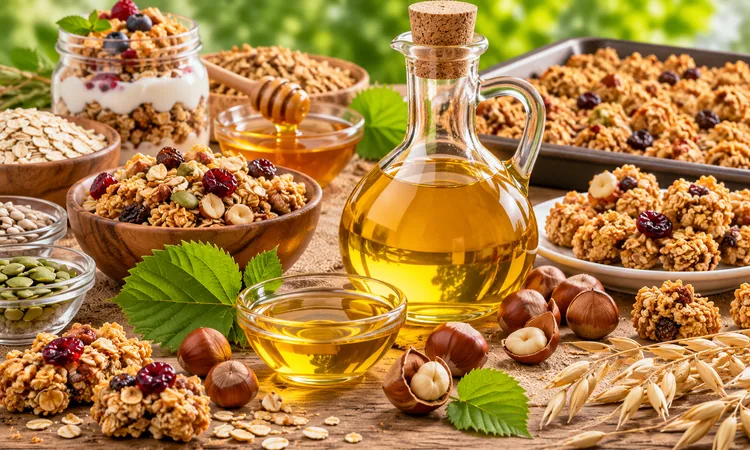
Overview. Industrial granola and cereal clusters typically combine oats, grains, nuts, seeds, sweeteners and other ingredients into baked or otherwise processed snack products. Refined hazelnut oil may be evaluated as a liquid vegetable oil component in selected coating mixtures, influencing ingredient coverage and sensory characteristics. Cluster structure depends primarily on the complete binder system, processing conditions and moisture management.
Refined Hazelnut Oil in Industrial Granola Formulations
Vegetable oils can serve several functions in granola manufacturing, including lubrication, ingredient coating, flavor distribution and modification of finished-product mouthfeel.
Refined hazelnut oil has a predominantly unsaturated fatty acid composition and may be investigated as part of the lipid phase in selected industrial granola recipes.
Its suitability depends on the desired granola texture, coating system, oven conditions and finished-product storage requirements. Liquid oil alone should not be treated as a complete replacement for adhesive binders.
Potential Granola and Cereal Cluster Applications
Refined hazelnut oil may be evaluated in different product concepts, including:
- Traditional baked granola: Assessment as part of the oil and syrup coating system used with oats and other ingredients.
- Crunchy cereal clusters: Evaluation of coating consistency, cluster size and breakage after baking and cooling.
- Nut and seed granola blends: Investigation alongside compatible nut, seed and grain ingredients.
- Specialty snack formulations: Controlled trials where a liquid vegetable oil component is required for the intended product.
Coating Uniformity and Oil Distribution
Uniform coating helps ensure consistent baking, flavor distribution and product appearance. Oil and syrup may be introduced separately or as part of a prepared coating mixture, depending on the production process.
Important manufacturing variables include oil dosing accuracy, coating viscosity, mixing time, ingredient particle size and batch loading. Uneven distribution can create differences in surface oiliness, browning and texture.
Production teams should compare representative samples throughout the batch rather than relying on visual appearance alone.
Syrup Binders and Cereal Cluster Formation
Granola cluster structure generally depends on the interaction of sweeteners or other suitable binding ingredients with grains and inclusions. Baking and cooling help establish the final texture and adhesion between particles.
Refined hazelnut oil may influence coating behavior, but it does not independently provide the adhesive properties required for firm cereal clusters.
A high proportion of liquid oil may interfere with binder effectiveness in some recipes. Formulators should therefore evaluate the balance between oil, syrup, dry ingredients and moisture.
Baking Conditions and Process Control
Industrial granola processing may include dry ingredient mixing, coating, spreading, baking, cooling and packaging. Each stage influences the final cluster structure.
Key production controls include:
- Accurate weighing of oil, syrup and dry ingredients.
- Consistent coating and mixing conditions.
- Oven temperature, residence time and product bed depth.
- Moisture removal and finished-product water activity.
- Cooling conditions before cluster separation.
- Handling intensity and breakage during transfer.
- Equipment hygiene, allergen management and traceability.
Excessive heat exposure should be avoided where it causes undesirable flavor changes, over-browning or oxidation. Actual baking conditions should be validated for the complete product rather than the oil alone.
Cluster Size, Crispness and Breakage
Cluster size and mechanical strength are important commercial quality parameters. Products may be designed for larger clusters, smaller pieces or a defined mix of particle sizes.
Manufacturers should assess cluster-size distribution, breakage during handling, crispness and bulk density. These attributes depend on binder composition, moisture, baking and cooling as well as the oil phase.
Controlled pilot batches can help establish whether a change to refined hazelnut oil concentration affects the target granola structure.
Oxidation Stability and Product Shelf Life
Refined hazelnut oil contains unsaturated fatty acids that can undergo oxidation under unfavorable storage conditions. Oxidation may influence flavor, aroma and overall product acceptability.
Shelf-life programs may include peroxide value and other suitable oxidation measurements, sensory evaluation, moisture, water activity, crispness and surface oil observations.
Granola commonly contains several lipid sources, including nuts and seeds. Stability must therefore be evaluated for the finished blend, not solely for the added refined hazelnut oil.
Packaging and Storage Considerations
Commercial granola packaging should protect the product against moisture uptake, unnecessary oxygen exposure and physical damage during distribution.
Packaging material selection may consider moisture and oxygen barrier performance, seal integrity and the expected storage environment.
Manufacturers should validate the packaged product under realistic distribution conditions, particularly where crispness and cluster integrity are key product characteristics.
Recommended Granola Production Trials
Manufacturers should begin with a reference granola formulation and compare controlled changes to the liquid oil component.
Relevant evaluations may include:
- Oil and syrup coating uniformity.
- Mixing consistency and ingredient coverage.
- Cluster-size distribution and mechanical breakage.
- Color development and baking consistency.
- Finished moisture, water activity and crispness.
- Surface oil, flavor and odor changes.
- Oxidation stability and packaged shelf life.
Results should be confirmed under representative industrial operating conditions before commercial-scale ingredient substitution.
Refined Hazelnut Oil Technical Specifications
Consistent incoming raw-material quality supports repeatable granola production. The stated product quality parameters include:
| Quality Parameter | Stated Value |
|---|---|
| Free Fatty Acids (FFA) | Maximum 0.3% |
| Moisture Content | Maximum 0.2% |
| Oleic Acid | 74.2–86.7% |
These figures are stated raw-material acceptance values and do not guarantee cluster strength, baking performance or finished-product shelf life.
Additional quality checks may be necessary for identity, oxidation, food safety and batch consistency according to the manufacturer's purchasing specification.
Review the refined hazelnut oil technical specifications and confirm current available documentation.
Allergen Management and Food Labeling
Hazelnut is a tree nut and must be considered under applicable food allergen labeling requirements. Manufacturers should review ingredient declarations, cross-contact controls and cleaning procedures before using refined hazelnut oil.
A refined oil ingredient should not automatically be assumed exempt from allergen requirements. The finished granola or cereal product must comply with the applicable rules of its destination market.
Bulk Refined Hazelnut Oil for Granola Manufacturers
Atlas Global Trading supplies refined hazelnut oil for international industrial and wholesale ingredient buyers, including manufacturers evaluating specialty vegetable oils for granola and cereal products.
Commercial packaging options include:
- 30 kg plastic drums: Smaller industrial purchasing format.
- 60 kg plastic drums: Intermediate bulk supply option.
- 200 kg plastic drums: Larger-volume industrial ingredient supply.
- Larger export and tanker formats: Subject to commercial volume and logistics feasibility.
Atlas Global Trading supplies refined hazelnut oil as a raw material, not finished granola, cereal clusters or ready-to-eat snack products.
Commercial Purchasing and Supply Planning
Industrial procurement teams should confirm the intended application, forecast oil consumption, order quantity, preferred packaging, destination country and receiving requirements.
Commercial discussions may cover current product specifications, available batch documents, traceability, shipment arrangements, delivery planning and relevant trade terms.
Manufacturers should qualify the proposed raw material and validate the granola formulation before committing to large-scale production purchases.
Share your expected purchasing volume, preferred packaging, delivery destination, granola or cereal cluster application and required technical documents. Our team will review your inquiry and discuss available commercial supply options.