
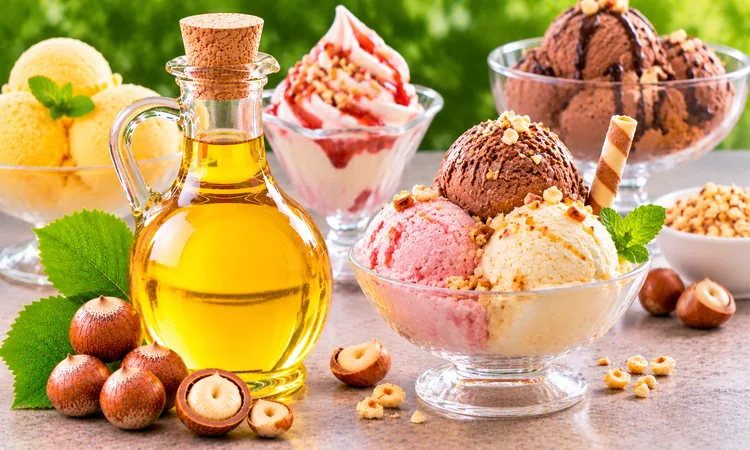
Overview. Frozen dessert products rely on carefully balanced fat, water, sugars, proteins, emulsifiers and stabilizers to achieve a suitable texture, air structure and melting profile. Refined hazelnut oil may be evaluated as a liquid vegetable oil component in selected experimental frozen dessert formulations. Its suitability depends on the complete fat system and controlled processing trials.
Refined Hazelnut Oil in Frozen Dessert Formulation
Fat influences body, mouthfeel, aeration and melting behavior in many frozen desserts. However, different fats have distinct physical properties, particularly their crystallization and solid fat content at low temperatures.
Refined hazelnut oil contains predominantly unsaturated fatty acids, especially oleic acid, and may be assessed as part of the liquid lipid fraction in suitable formulations.
It does not replicate the crystallization behavior of dairy fat or specialized structured vegetable fats. As a result, direct substitution may influence texture, foam stability and melting performance.
Potential Frozen Dessert Applications
Manufacturers may investigate refined hazelnut oil in selected product development projects, including:
- Vegetable-fat frozen desserts: Evaluation within a balanced fat blend designed for the required frozen structure.
- Non-dairy frozen dessert formulations: Investigation as one oil ingredient alongside suitable proteins, emulsifiers and stabilizers.
- Specialty frozen dessert mixes: Controlled assessment of sensory properties and compatibility with the complete recipe.
- Experimental ice cream-related formulations: Comparison of modified fat systems while observing applicable product composition and labeling rules.
These are potential formulation uses, not guarantees of suitability or claims that refined hazelnut oil is a direct dairy fat replacement.
Fat Crystallization and Structural Function
In many aerated frozen desserts, a portion of the fat must crystallize under controlled conditions to help support the structure developed during freezing.
The balance of liquid and crystalline fat affects partial coalescence, air bubble stabilization and resistance to structural collapse.
Increasing the proportion of liquid oil can alter these mechanisms. Formulators should evaluate the complete fat blend and its solid fat content across relevant temperatures instead of relying solely on the oil's fatty acid composition.
Emulsifiers, Stabilizers and Mix Compatibility
Frozen dessert mixes commonly contain emulsifiers and stabilizers to help manage fat dispersion, water mobility, viscosity and texture.
The selected emulsifier system must be compatible with the fat composition and intended manufacturing process. Adjusting the oil fraction may require corresponding changes elsewhere in the recipe.
Important considerations include fat droplet size, protein interactions, mix viscosity, stability during aging and behavior during dynamic freezing.
Homogenization and Pasteurization Controls
Industrial frozen dessert mix production may involve controlled ingredient blending, pasteurization, homogenization, cooling and aging.
Homogenization influences the size and distribution of fat droplets within the emulsion. Actual results depend on equipment, fat composition, temperature, pressure and emulsifier selection.
Production teams should verify that the revised formulation remains stable during processing and does not show undesirable oil separation.
Applicable heat-treatment and food safety requirements must be established for the complete mix.
Mix Aging, Freezing and Fat Destabilization
Mix aging allows physical changes to occur before freezing, including fat crystallization where the formulation contains suitable crystalline fats.
During freezing, controlled partial fat destabilization can contribute to the structure of certain aerated frozen desserts. Too little or too much destabilization may affect body, texture and melting characteristics.
Because refined hazelnut oil is predominantly liquid, its use should be evaluated in combination with the other components of the fat system.
Overrun and Air Incorporation
Overrun describes the increase in product volume caused by air incorporation during freezing. It is an important quality and process parameter for many industrial frozen desserts.
Fat structure, emulsifiers, stabilizers, mix viscosity and freezer conditions can all influence air incorporation and retention.
Manufacturers should compare overrun, air cell structure and product consistency using controlled reference and experimental batches.
Melting Behavior and Mouthfeel
Finished frozen dessert performance depends on ice crystals, air cells, fat structure and the unfrozen serum phase.
Changing the fat composition may influence melting resistance, firmness, perceived creaminess and overall mouthfeel.
Relevant measurements include first-drip time, melt rate, product shape retention, texture and sensory properties under standardized conditions.
The desired melting profile should be established through complete finished-product testing.
Industrial Production and Cold Chain Management
Commercial frozen dessert manufacture requires repeatable processing and appropriate temperature control from ingredient preparation through distribution.
Relevant process controls include:
- Ingredient identification, weighing and oil dosing.
- Mix composition and emulsification uniformity.
- Pasteurization and hygienic process control.
- Homogenization conditions and mix cooling.
- Aging temperature and residence time.
- Freezing conditions, overrun and product consistency.
- Hardening, packaging and frozen storage temperature.
Frozen distribution conditions should be validated because temperature fluctuation may affect ice crystal growth, texture and finished-product quality.
Oxidation Stability and Frozen Storage Quality
Unsaturated vegetable oils can undergo oxidation under unfavorable storage and handling conditions. Although freezing slows many deterioration processes, it does not eliminate all quality changes.
Product development should consider odor and flavor stability, oxidation indicators, packaging protection and the behavior of the full formulation during its intended frozen shelf life.
Shelf-life studies should also monitor ice crystal development, texture and any undesirable changes caused by temperature cycling.
Recommended Frozen Dessert Formulation Trials
Manufacturers should begin with a reference formulation and test controlled changes to the oil and fat system.
Relevant trial measurements may include:
- Mix viscosity and emulsion stability.
- Fat droplet distribution and crystallization behavior.
- Homogenization and aging performance.
- Overrun and air structure.
- Melting resistance and first-drip behavior.
- Texture, mouthfeel and sensory quality.
- Oxidation indicators and frozen storage stability.
- Microbiological safety and packaging integrity.
Commercial-scale validation should follow successful pilot trials using representative equipment and process conditions.
Refined Hazelnut Oil Technical Specifications
Consistent raw-material quality supports controlled formulation trials and industrial procurement. The stated quality parameters include:
| Quality Parameter | Stated Value |
|---|---|
| Free Fatty Acids (FFA) | Maximum 0.3% |
| Moisture Content | Maximum 0.2% |
| Oleic Acid | 74.2–86.7% |
These values describe stated raw-material acceptance parameters. They do not guarantee fat crystallization, overrun, melting resistance or the performance of any finished frozen dessert.
Additional testing may be required according to the manufacturer's purchasing specifications and food safety program.
Review the refined hazelnut oil technical specifications and confirm current available batch documentation before purchasing.
Allergen Management and Product Classification
Hazelnut is a tree nut, and applicable allergen labeling requirements must be considered when developing frozen dessert products.
Manufacturers should also review ingredient declarations, cross-contact controls and destination-market food safety requirements.
Products marketed as ice cream may be subject to specific legal composition or naming rules. In certain markets, changing the source of the fat may affect the permitted product designation.
The finished product must comply with the applicable classification and labeling requirements of its intended destination market.
Bulk Refined Hazelnut Oil for Frozen Dessert Manufacturers
Atlas Global Trading supplies refined hazelnut oil to international industrial and wholesale ingredient buyers, including manufacturers evaluating specialty vegetable oils for frozen dessert formulation projects.
Commercial packaging formats include:
- 30 kg plastic drums: Smaller industrial purchasing format.
- 60 kg plastic drums: Intermediate bulk supply option.
- 200 kg plastic drums: Larger-volume industrial ingredient requirements.
- Larger export and tanker formats: Subject to order volume and logistics feasibility.
Atlas Global Trading supplies refined hazelnut oil as a bulk raw material, not finished ice cream, frozen desserts or prepared ice cream mixes.
Commercial Procurement and Supply Planning
Professional ingredient buyers should confirm their intended application, required oil grade, forecast consumption, packaging preference, delivery destination and receiving arrangements.
Commercial discussions may address current specifications, available quality documents, batch traceability, shipment planning, storage requirements and relevant trade terms.
Manufacturers should qualify the proposed raw material and validate the finished-product fat system before committing to commercial-scale use.
Share your purchasing quantity, preferred packaging, delivery destination, intended frozen dessert application and technical documentation requirements. Our team will review your inquiry and discuss available commercial supply options.