
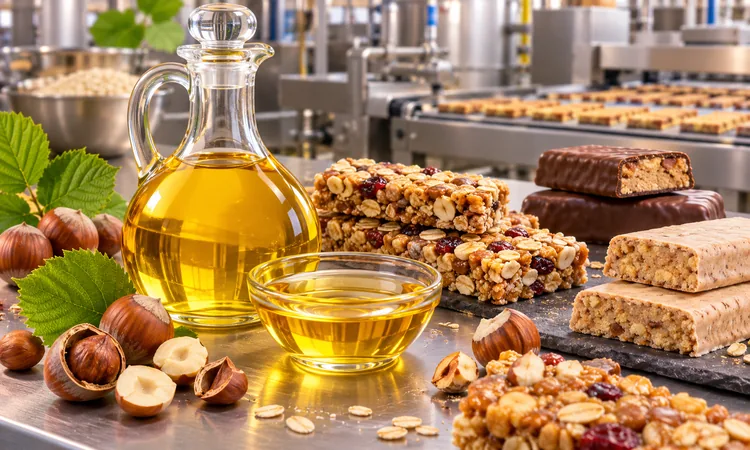
Technical and Commercial Overview
Cereal and protein bars require a carefully designed balance between ingredient binding, chewiness, firmness, moisture control, fat distribution and long-term physical stability.
Refined hazelnut oil may be considered as a component of the liquid fat phase in selected snack bar formulations. Its role depends on the complete product composition and the desired finished texture.
A snack bar can contain cereals, protein ingredients, syrups, fibers, nut preparations, cocoa components, structured fats and other materials. These ingredients interact during mixing, forming, cooling, packaging and storage.
The introduction of a liquid oil may influence lubrication, perceived softness, ingredient distribution and mouthfeel. However, excessive oil mobility or unsuitable fat compatibility may contribute to migration, packaging staining or changes in the bar's structure.
This guide examines the main technical considerations for evaluating refined hazelnut oil in commercial cereal and protein bar production, together with the quality documentation, packaging options and purchasing information relevant to industrial buyers.
1. Refined Hazelnut Oil in Cereal and Protein Bar Manufacturing
Snack bars vary substantially in formulation, processing method and intended eating characteristics. Some products use syrup-based binders, while others depend on protein-rich matrices, nut butters, fats or combinations of ingredients to maintain their shape.
Refined hazelnut oil can be evaluated within the fat phase of suitable recipes, but it is not a complete binder, protein source or structural replacement for all existing bar ingredients.
Cereal Bars
Cereal bars may contain oats, puffed grains and other particles held together with a suitable binder. Liquid oil can influence lubrication and texture, subject to the formulation.
Protein Bars
High-protein formulations can have complex interactions between proteins, binders, water and fats. Liquid oil may be investigated for its effect on texture and eating quality.
Granola Bars
Granola-style bars may require a balance between cohesion, crispness and acceptable breakage. The fat phase can influence coating and ingredient distribution.
Nut-Containing Snack Bars
Products containing nuts or nut preparations may already have significant intrinsic oil content. Additional liquid oil must be assessed against the complete fat balance and product structure.
Role of the Liquid Fat Phase
Liquid oil can contribute to the distribution of lipid-compatible ingredients and may influence lubrication between solid particles within a bar matrix.
Depending on the formula, this may change perceived softness, chewiness, mouthfeel and processing behavior.
The outcome depends on ingredient proportions, protein and fiber composition, binder characteristics, moisture, processing and storage.
Choosing a Product Development Objective
Manufacturers should define what they are attempting to improve before changing the fat system.
- Adjusting the texture of a protein-rich bar.
- Evaluating softness or chewiness during storage.
- Changing the fat composition of an existing formulation.
- Improving mixing or ingredient distribution.
- Evaluating sensory properties and mouthfeel.
- Maintaining bar integrity during cutting and packaging.
- Controlling oil migration and wrapper staining.
- Assessing compatibility with coatings or layers.
These are potential formulation objectives, not guaranteed performance benefits from adding refined hazelnut oil.
2. Technical Properties of Refined Hazelnut Oil
Raw material characterization is essential when evaluating an oil for industrial snack bar formulations.
Refined hazelnut oil is characterized by its fatty-acid composition, oxidation condition and selected physical and chemical properties.
| Parameter | Published specification | Snack bar relevance |
|---|---|---|
| Composition | 100% refined hazelnut oil | Ingredient identity and formulation declaration. |
| Oleic acid | 74.2–86.7% | Dominant monounsaturated fatty acid. |
| Linoleic acid | 5.2–18.7% | Polyunsaturated fatty-acid component. |
| Palmitic acid | 4.2–8.9% | Part of the saturated fatty-acid fraction. |
| Stearic acid | 0.8–3.2% | Additional saturated fatty-acid component. |
| Free fatty acids | Maximum 0.3% | Indicator relevant to refining quality and oil condition. |
| Moisture | Maximum 0.2% | Relevant to ingredient handling and storage quality. |
| Peroxide value | Maximum 10 meq/kg | Indicator of primary lipid oxidation. |
| Density at 20°C | 0.898–0.915 | Relevant to physical characterization and oil transfer. |
| Iodine value | 81–92 | Characterizes fatty-acid unsaturation. |
| Saponification value | 188–198 mg KOH/g | Additional oil characterization. |
| Refractive index at 20°C | 1.468–1.473 | Supports physical identity assessment. |
| Insoluble impurities | Maximum 0.05% (m/m) | Ingredient cleanliness and quality assessment. |
High Oleic Acid Composition
Oleic acid represents the dominant fatty-acid fraction in refined hazelnut oil.
Its composition may be relevant to liquid fat behavior and oxidation, but fatty-acid composition alone cannot determine the finished protein bar's shelf life, texture or resistance to oil migration.
Oxidation Condition
Unsaturated vegetable oils can undergo oxidative changes during storage, especially under unfavorable conditions involving oxygen, heat, light or other interacting ingredients.
Raw material oil quality should therefore be assessed alongside the oxidation stability of the finished snack bar.
Oil Fluidity
Refined hazelnut oil is a liquid fat under ordinary handling conditions.
Its mobility should be considered when the formulation contains porous cereal particles, nut ingredients, proteins, fibers or structured coatings.
3. Binder Systems in Cereal and Protein Bars
Binding is a fundamental aspect of snack bar manufacture. A bar must maintain enough cohesion to survive cutting, wrapping, transportation and handling.
Different products rely on different binder systems. The suitability of refined hazelnut oil depends on its interaction with the chosen ingredients.
Syrup-Based Binders
Sugar syrups and other compatible binders may contribute to particle adhesion and cohesion. Added liquid oil can affect the balance of the system and should be assessed experimentally.
Protein-Rich Matrices
Protein ingredients can affect moisture interactions, mechanical behavior and bar firmness. Fat-phase changes may alter texture and cohesion.
Nut and Seed Preparations
Nut butters and seed pastes contain both solids and oils. Their existing fat content must be considered before adding further liquid oil.
Fiber-Containing Systems
Fibers can influence water distribution, texture and structural properties. Oil compatibility may depend on the fiber type and complete ingredient balance.
Oil Does Not Replace Every Binder Function
Refined hazelnut oil can be evaluated as a fat-phase ingredient, but it does not independently provide the entire binding function required to maintain a cereal or protein bar's shape.
The product's cohesion depends on interactions among proteins, syrups, fibers, particles, fats and moisture.
Binder Compatibility Trials
Formulation developers should compare a control recipe with appropriately designed experimental batches.
Relevant measurements may include cohesion, breakage, compression, cutting performance and oil release.
4. Interactions Between Refined Hazelnut Oil and Protein Ingredients
Protein bars often contain concentrated protein ingredients that behave differently from conventional cereal components.
Protein type, particle characteristics, hydration, syrup composition and processing history may influence the final bar texture.
Protein Powder Dispersion
Protein ingredients need to be incorporated evenly throughout the bar matrix.
Incomplete mixing may create dry regions, uneven texture or inconsistent ingredient distribution.
A liquid oil may influence how ingredients interact during mixing, but this behavior should be validated for the chosen protein system.
Texture Changes During Storage
Protein-rich bars can change in firmness or chewiness during storage due to interactions among proteins, moisture, sugars and other ingredients.
Liquid fat selection may affect some physical characteristics, but cannot be assumed to prevent hardening or other texture changes.
Fat Distribution
Uniform fat distribution may be important for consistent sensory properties.
Excessively localized fat or poor incorporation may contribute to nonuniform texture and potential oil migration.
Protein Sources and Allergen Implications
Protein bars may contain milk-derived, soy-derived or other protein ingredients.
These materials can introduce additional allergen considerations, which must be assessed alongside any hazelnut-derived oil.
5. Firmness, Chewiness and Snack Bar Texture
Product texture is one of the most important quality attributes of cereal and protein bars.
Manufacturers must achieve the intended balance between softness, chewiness, cohesion and breakage.
Firmness
Firmness depends on the binder system, solids composition, protein interactions, fat structure and storage conditions.
Chewiness
Chewiness reflects the mechanical and sensory response of the full bar matrix. Liquid oil may influence perceived texture in suitable systems.
Cohesion
A bar must resist unwanted crumbling or separation during cutting, handling and distribution.
Mouthfeel
The balance of fats, proteins, fibers and other ingredients influences lubrication, perceived dryness and the eating experience.
Instrumental Texture Analysis
Depending on the product, manufacturers may employ suitable compression, penetration, bending or other mechanical tests to evaluate bar texture.
Results should be obtained under defined measurement conditions and compared with an approved reference or control formulation.
Temperature and Texture
Texture can change as the product warms or cools.
Elevated temperatures may influence the behavior of certain binder systems and fat-containing components.
Manufacturers should determine whether the finished bar maintains acceptable handling and eating characteristics throughout its intended distribution conditions.
6. Fat Migration, Oil Leakage and Wrapper Staining
Oil migration is a significant consideration in snack bar formulations containing liquid fats.
During storage, some mobile oil may move through the bar matrix or come into contact with the packaging material.
This can affect appearance, surface condition, texture and packaging presentation.
Oil Migration
Mobile liquid oil may redistribute within the product over time. Ingredient absorption, fat content and matrix structure influence the outcome.
Wrapper Staining
Oil may migrate toward product packaging and cause visible staining or changes in appearance, depending on the wrapper and product formulation.
Surface Oil
Liquid oil can become visible on the bar's surface if the product structure does not adequately retain it.
Temperature Sensitivity
Higher storage temperatures may increase the mobility of certain fat components and expose weaknesses in the formulation.
Factors Influencing Migration
- Total liquid oil concentration in the formulation.
- Oil naturally present in nuts, seeds and other ingredients.
- Ability of the matrix to retain the liquid fat.
- Fat compatibility with other lipid components.
- Particle size and ingredient structure.
- Processing and mixing conditions.
- Storage temperature and duration.
- Packaging material properties and compatibility.
Wrapper Compatibility
The selected packaging should be evaluated with the actual finished product.
Packaging tests may include visible staining, seal integrity, material compatibility and performance after realistic storage.
Manufacturers should not assume that a wrapper suitable for one snack bar will behave identically with another fat composition.
7. Chocolate Coatings, Fat Bloom and Layer Compatibility
Some cereal and protein bars contain chocolate, compound coatings or other fat-based layers.
The compatibility of the bar's internal fat phase with the outer coating may be important for appearance, texture and long-term stability.
Liquid Oil Migration into Coatings
A mobile liquid fat may migrate from the bar center into a fat-based coating.
Depending on the coating composition, this can influence fat structure, surface appearance or texture.
Chocolate Fat Bloom
Certain chocolate coatings can develop visible fat-related surface changes under inappropriate formulation or storage conditions.
Oil migration can interact with some chocolate fat systems, but the exact mechanism and severity depend on the complete formulation.
Compound Coating Compatibility
Compound coatings may employ different fat systems from conventional cocoa-butter-based chocolate.
Manufacturers should assess the compatibility of the selected coating with the underlying bar filling or matrix.
Storage Testing of Coated Bars
Relevant observations may include coating cracking, bloom, appearance changes, adhesion, texture and oil migration after storage.
8. Industrial Production and Processing Considerations
Commercial cereal and protein bar production requires consistent ingredient handling, mixing, forming, cutting, cooling and packaging.
Changing the liquid fat phase may influence the behavior of the mixture during several processing stages.
Ingredient Receiving
Incoming refined hazelnut oil should be inspected according to the manufacturer's approved raw material procedures.
Checks may include packaging condition, product identification, available batch documentation, and selected quality parameters.
Oil Incorporation During Mixing
The method used to incorporate liquid fat should be appropriate for the chosen binder and solid ingredient system.
Incomplete or excessive mixing may affect ingredient distribution and structural consistency.
Forming and Compression
Snack bar production may involve pressing, rolling, extrusion or other suitable forming operations.
The mixture should have suitable cohesion and handling properties for the selected process.
Cutting and Product Integrity
Bars must maintain suitable shape and integrity during cutting and transfer.
Excessive softness, stickiness or crumbling can affect manufacturing efficiency and product consistency.
Cooling and Packaging
Cooling and packaging conditions may influence structural stability, surface characteristics and coating performance.
The finished product should be evaluated under the actual industrial packaging and distribution process.
Suggested Pilot Production Sequence
- Define the intended finished product. Establish target texture, shape, composition, coating and packaging.
- Qualify raw materials. Review refined hazelnut oil and the other formulation ingredients.
- Document a control formulation. Establish reference ingredient proportions and process conditions.
- Prepare controlled trial formulations. Evaluate candidate oil levels without unnecessarily changing multiple variables at once.
- Assess mixing and forming. Record ingredient distribution, process behavior and cohesion.
- Measure texture. Compare firmness, chewiness and breakage.
- Evaluate fat migration. Inspect surface oil, packaging and coated layers.
- Conduct safety and stability testing. Assess the finished product using appropriate quality controls.
- Verify commercial-scale consistency. Confirm repeatable manufacturing performance and finished-product quality.
9. Food Safety, Water Activity and Allergen Management
Cereal and protein bars require appropriate food safety controls based on the actual formulation, ingredients, production process and intended storage conditions.
Water Activity
Water activity is important in many shelf-stable snack bar systems.
It is distinct from total moisture content and influences the availability of water for microbial growth and certain ingredient interactions.
The appropriate water activity specification should be established for the finished bar through suitable food safety evaluation.
Moisture Migration
Bars containing ingredients with different moisture characteristics may experience water redistribution during storage.
This can influence texture, crispness, hardness and shelf-life performance.
Microbiological Safety
Low-moisture products can present food safety risks and should not be assumed free of relevant microorganisms.
Manufacturers should implement appropriate ingredient controls, sanitation, process validation and microbiological risk assessment.
Hazelnut Allergen Considerations
Hazelnuts are regulated tree-nut allergens in many food markets.
The residual allergen implications of refined hazelnut oil must be assessed using the relevant processing information and applicable requirements.
Refining should not automatically be assumed to establish an allergen-free ingredient.
Additional Allergen Sources
Depending on the recipe, protein bars may also contain milk, soy, peanuts, other tree nuts or allergenic ingredients.
Finished-product allergen declarations must be based on the complete composition and the laws of the market where the product is sold.
10. Oxidation, Warm-Temperature Stability and Shelf Life
Snack bars may be stored for extended periods and distributed through varying environmental conditions.
Their quality can change because of oxidation, fat migration, moisture redistribution and other physical or chemical processes.
Oxidation of the Fat Phase
Refined hazelnut oil contains unsaturated fatty acids that may undergo oxidation during storage.
Light, oxygen, heat and the presence of other ingredients can influence the oxidation behavior of the finished bar.
Manufacturers should select suitable oxidation indicators and sensory evaluations for their finished product.
Warm-Temperature Testing
Elevated temperatures may influence the softness of a bar, the mobility of liquid fat and the stability of certain coatings.
Warm-temperature testing should reflect reasonably foreseeable warehousing and distribution conditions.
Packaging and Oxygen Exposure
Snack bar packaging can influence oxygen and moisture exposure, depending on the selected barrier materials and package design.
The finished product's packaging must also be assessed for oil staining, seal performance and material compatibility.
Raw Material Versus Finished-Product Shelf Life
The supplied refined hazelnut oil information states a 24-month shelf life under specified storage conditions.
This does not mean a finished cereal or protein bar containing the oil automatically has a 24-month shelf life.
Finished-product shelf life must be determined through appropriate stability and food safety validation.
Suggested Shelf-Life Evaluation
- Firmness and chewiness over time.
- Oil migration and visible surface oil.
- Wrapper staining or packaging interaction.
- Chocolate or coating appearance, where relevant.
- Oxidation indicators and sensory changes.
- Moisture and water activity as appropriate.
- Product cohesion and breakage.
- Warm-temperature and realistic distribution trials.
- Applicable food safety and microbiological criteria.
11. Quality Control and Industrial Product Testing
Raw material acceptance and finished-product performance should be evaluated through separate but coordinated quality procedures.
The supplied oil specification describes the raw ingredient, while the snack bar manufacturer must define acceptance criteria for the finished bar.
| Evaluation | Purpose | Typical observation |
|---|---|---|
| Oil identity | Confirm the intended raw material. | Specification, batch identification and documentation. |
| Oil oxidation | Assess incoming oil condition. | Peroxide value and relevant quality indicators. |
| Mixing uniformity | Assess ingredient distribution. | Uniformity of oil, proteins, binders and solids. |
| Binder cohesion | Evaluate structural integrity. | Crumbling, breakage and forming consistency. |
| Firmness | Evaluate mechanical texture. | Compression or other suitable measurements. |
| Chewiness | Assess finished-product sensory character. | Instrumental and sensory observations. |
| Oil migration | Evaluate fat retention. | Oil movement, surface changes and separation. |
| Wrapper staining | Assess packaging interaction. | Visible oil staining after storage. |
| Coating stability | Evaluate coated bar performance. | Bloom, cracking, adhesion and appearance. |
| Water activity | Support product stability and food safety review. | Measured value under defined conditions. |
| Thermal stability | Evaluate warm-storage performance. | Texture, oil migration and packaging observations. |
| Sensory stability | Monitor eating quality. | Flavor, aroma, mouthfeel and texture changes. |
| Food safety | Support finished-product validation. | Relevant controls and microbiological evaluation. |
| Shelf-life testing | Establish product storage performance. | Validated observations over the intended shelf life. |
Reference Versus Experimental Batches
Manufacturers should compare the existing approved formulation with controlled trials containing the proposed refined hazelnut oil adjustment.
Processing conditions and measurement methods should be kept sufficiently consistent to allow meaningful comparisons.
Quality Documentation
An incoming raw material specification defines general acceptance criteria.
Where available, a lot-specific certificate of analysis may provide actual analytical results for selected parameters.
Buyers should specify their documentation requirements during supplier qualification.
12. Bulk Refined Hazelnut Oil Procurement for Snack Bar Manufacturers
Atlas Global Trading focuses on international bulk supply inquiries for 100% refined hazelnut oil.
Manufacturers evaluating the oil for cereal, granola or protein bar production should identify the required quality parameters, packaging format, shipment volume and destination.
Industrial Packaging Formats
| Packaging format | Published quantity | Commercial consideration |
|---|---|---|
| Plastic drum | 30 kg net | Smaller industrial handling units and inventory flexibility. |
| Plastic drum | 60 kg net | Intermediate manufacturing quantities. |
| Plastic drum | 200 kg net | Larger manufacturing demand with appropriate handling equipment. |
| Export flexitank | Shipment-dependent | Containerized bulk liquid transport subject to approved equipment and route suitability. |
| Bulk road tanker | 20 tonnes and above | High-volume delivery requiring suitable receiving infrastructure. |
Choosing the Packaging Format
Drum packaging may be appropriate when a manufacturing facility requires separate handling units or controlled inventory.
Larger bulk formats may be considered when the buyer has suitable storage and liquid transfer infrastructure.
The packaging choice can affect freight, unloading, warehouse costs and operational efficiency.
Technical Documentation
Industrial food manufacturers may require a current product specification, available lot-specific test results, allergen information and traceability records.
Any required additional analytical testing or supporting documents should be identified before confirming a commercial order.
International Supply
Buyers should provide the destination country, delivery location and relevant import documentation requirements.
The final commercial agreement should address packaging, shipment terms, agreed quantity, documentation and delivery conditions.
Information to Include in a Bulk Quotation Request
- Product: 100% refined hazelnut oil.
- Application: cereal, granola, protein or other snack bar manufacturing.
- Required net quantity in kilograms or metric tonnes.
- Preferred packaging format.
- Destination country and delivery location.
- Required technical specifications and acceptance limits.
- Requested quality, allergen or analytical documentation.
- Preferred shipment or delivery period.
- Receiving and storage equipment requirements.
- Whether purchasing is one-time or recurring.
For additional information, visit the bulk packaging page or review international export and logistics information .
13. Key Technical Considerations
- Refined hazelnut oil may be evaluated as a liquid fat ingredient in selected cereal and protein bar formulations.
- Oil is only one component of the complete binder and structural system.
- Protein, syrup, fiber and moisture interactions influence bar texture.
- Fat-phase changes may affect softness, firmness, chewiness and cohesion.
- Liquid oil migration and wrapper staining are important storage concerns.
- Chocolate or fat-based coatings require appropriate compatibility assessment.
- Warm-temperature testing is relevant to product distribution and packaging.
- Oxidation and finished-product shelf life require specific evaluation.
- Hazelnut-related allergen implications must be reviewed in the intended market.
- Bulk procurement requires agreement on specifications, packaging, quantity, documentation and commercial terms.
Request Bulk Refined Hazelnut Oil for Cereal and Protein Bar Manufacturing
Developing cereal bars, granola bars, protein bars or related snack formulations? Contact Atlas Global Trading with your intended application, required quantity, packaging preference, destination and technical requirements to discuss a wholesale supply inquiry.
Contact Our Sales TeamRelated Industrial Application Articles
This article provides general technical and commercial guidance. It is not a validated recipe, a finished-product safety approval or a guarantee of manufacturing performance. Manufacturers remain responsible for formulation testing, allergen management, shelf-life validation, applicable regulatory compliance and purchasing qualification.