
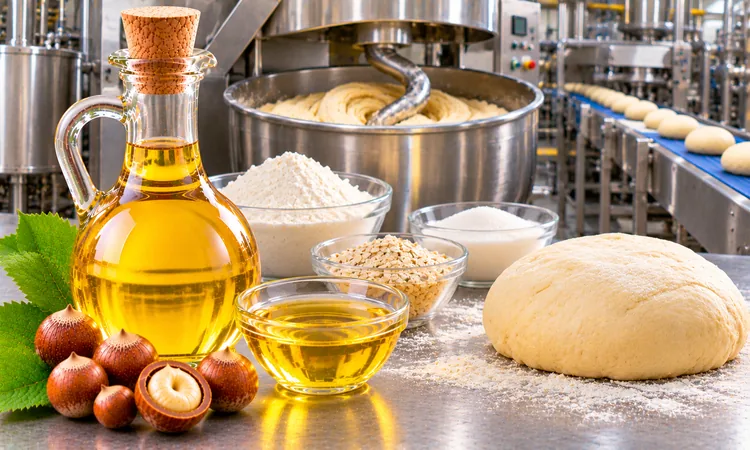
Overview. Edible oils can influence lubrication, ingredient distribution and handling characteristics in selected food formulations. Refined hazelnut oil may be evaluated as a liquid lipid ingredient where dough processing, mixing consistency and ingredient flow are relevant. Such edible formulation uses must be distinguished from technical machine lubrication and food-contact release applications.
Refined Hazelnut Oil in Food Ingredient Handling
Food manufacturing involves moving, mixing and processing ingredients with different physical properties. In suitable formulations, liquid oils can reduce friction between food components, influence lubrication and affect the way ingredients are distributed.
Refined hazelnut oil has a predominantly unsaturated fatty acid composition and may be investigated as one component of a food product's lipid phase.
Its effectiveness depends on the complete recipe, processing conditions and the performance required from the finished product.
Potential Edible Formulation Applications
Refined hazelnut oil may be evaluated where the lubricant-like behavior of an edible oil contributes to formulation handling.
- Dough and batter systems: Investigation of oil distribution and its influence on mixing and handling behavior.
- Food ingredient blending: Evaluation of liquid oil as part of a compatible dry or semi-solid ingredient mix.
- Paste and filling formulations: Assessment of lipid-phase effects on flow, consistency and processing.
- Selected food processing systems: Controlled trials involving edible oil functionality within an approved recipe.
These applications concern the oil as a food ingredient. They do not establish suitability for machinery lubrication or separate technical processing-aid uses.
Lubricity, Dough Handling and Mixing Behavior
Oils can influence internal friction, ingredient wetting and physical interactions within a dough or paste formulation.
Important factors include the oil concentration, flour or other solid ingredients, moisture, mixing time and operating temperature.
Changing the oil phase may influence dough cohesion, mixing resistance, stickiness and consistency. Manufacturers should compare these properties against an established reference formulation.
Ingredient Flow and Product Consistency
In pastes and semi-solid food systems, the liquid fat phase may influence flow and handling characteristics.
The relationship between liquid oil, particle size, total solids and other ingredients affects viscosity and physical stability.
Excessive oil content may alter the finished product's texture or cause undesirable oil separation. Appropriate formulation testing is therefore essential.
Edible Ingredient Use Versus Technical Lubrication
Refined hazelnut oil supplied for edible ingredient use is not automatically an approved machinery lubricant, hydraulic fluid, conveyor lubricant or food-contact release agent.
Technical lubrication applications can require specific performance characteristics, approvals and compliance with applicable regulations. These requirements are distinct from those governing ordinary food ingredients.
Manufacturers should consult their engineering, quality and food-safety teams before considering any use outside an approved food formulation.
No technical lubricant or food-contact release-agent certification is claimed for the supplied refined hazelnut oil.
Bulk Oil Reception and Ingredient Transfer
Industrial receiving operations should protect refined hazelnut oil against contamination, unwanted mixing and excessive environmental exposure.
Relevant considerations include container condition, documented ingredient identity, unloading procedures and the suitability of receiving equipment.
Transfer lines, pumps and storage equipment should be compatible with edible oil handling and appropriate for the site's hygiene and cleaning requirements.
Pumping, Temperature and Oxygen Exposure
Bulk oil transfer should use controlled pumping conditions designed for the selected equipment and operating environment.
Manufacturers should consider temperature, viscosity, pumping rate, line cleanliness and the potential introduction of air.
Unsaturated oils can undergo oxidation during unfavorable handling and storage. Avoiding unnecessary heat, light and oxygen exposure can help protect ingredient quality.
Hygienic Handling, Cleaning and Traceability
Food manufacturers should apply suitable hygiene procedures when receiving, transferring and processing bulk edible oils.
Important controls may include:
- Verification of incoming containers and batch identification.
- Use of suitable food-contact equipment and transfer materials.
- Documented cleaning and sanitation procedures.
- Prevention of cross-contact with incompatible ingredients.
- Appropriate allergen segregation and line changeover controls.
- Monitoring of temperature and storage conditions.
- Batch traceability throughout ingredient transfer and production.
Equipment validation and cleaning procedures should be established according to the facility's food safety management system.
Recommended Production and Formulation Trials
Manufacturers should begin with an existing validated formulation and assess controlled changes to the added liquid oil component.
Relevant trial measurements may include:
- Dough consistency and mixing resistance.
- Ingredient wetting and distribution uniformity.
- Adhesion, stickiness and handling behavior.
- Viscosity and flow characteristics.
- Oil separation or changes in physical stability.
- Oxidation indicators and sensory quality.
- Finished-product texture and storage stability.
Results should be compared under consistent processing conditions before commercial formulation changes are adopted.
Refined Hazelnut Oil Technical Specifications
Consistent raw-material specifications support industrial ingredient qualification and repeatable production.
The stated refined hazelnut oil quality values include:
| Quality Parameter | Stated Value |
|---|---|
| Free Fatty Acids (FFA) | Maximum 0.3% |
| Moisture Content | Maximum 0.2% |
| Oleic Acid | 74.2–86.7% |
These values describe stated raw-material acceptance parameters. They do not establish mechanical lubricating performance, equipment compatibility or suitability for any technical lubrication application.
Additional analytical checks may be required according to the buyer's food safety and purchasing requirements.
Review the refined hazelnut oil technical specifications and confirm current available documentation before procurement.
Allergen Management and Food Safety
Hazelnut is a tree nut. Food manufacturers should review ingredient declarations, allergen cross-contact controls and applicable destination-market labeling requirements.
Bulk transfer systems may require segregation, cleaning validation or documented changeover controls where different ingredient types share equipment.
Refined oil should not automatically be treated as exempt from applicable allergen and food safety requirements.
Bulk Refined Hazelnut Oil Supply
Atlas Global Trading supplies refined hazelnut oil to international industrial and wholesale ingredient buyers, including food manufacturers evaluating liquid edible oils for formulation and processing applications.
Commercial packaging options include:
- 30 kg plastic drums: Smaller industrial purchasing format.
- 60 kg plastic drums: Intermediate bulk supply option.
- 200 kg plastic drums: Larger-volume industrial ingredient purchasing.
- Larger export and tanker formats: Subject to order volume and logistics feasibility.
The product is supplied as refined hazelnut oil for industrial ingredient procurement, not as a qualified machinery lubricant or technical fluid.
Commercial Procurement and Supply Planning
Purchasing teams should confirm the intended edible application, order volume, required oil grade, packaging preference, destination and receiving arrangements.
Commercial discussions may include current product specifications, available batch documentation, shipment planning, storage requirements and relevant international trade terms.
Buyers should coordinate ingredient qualification with food safety, production and engineering teams before adopting any new oil-handling process.
Provide your purchasing quantity, preferred packaging, delivery destination, intended edible formulation application and technical documentation needs. Our team will review your inquiry and discuss available bulk supply options.