
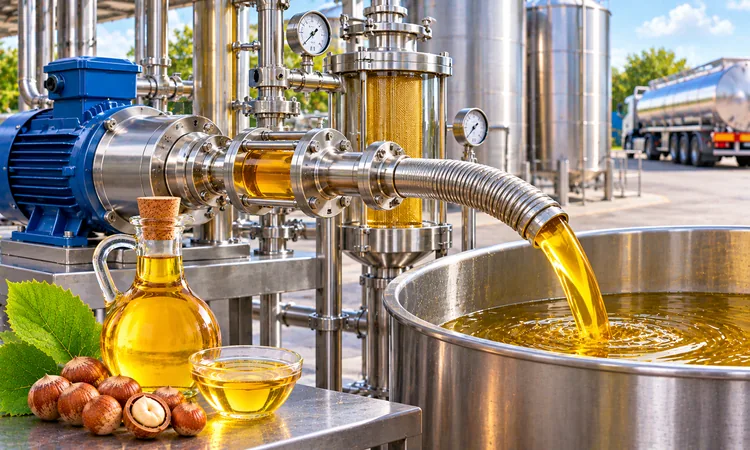
Technical and Commercial Overview
Efficient bulk handling of refined hazelnut oil requires more than selecting an appropriate pump. Industrial facilities must also consider product identity, flow requirements, suction conditions, piping, hygienic design, oxygen exposure, filtration, storage capacity and cleaning procedures.
Refined hazelnut oil is supplied as a liquid vegetable oil and may be received in drums or suitable larger bulk transport systems. The receiving facility must have equipment appropriate for the selected packaging format and intended transfer operation.
Incorrect pump selection, unsuitable hoses, excessive pressure losses, poor sanitation or improper tank allocation can introduce quality, operational and safety risks.
For industrial buyers, transfer-system compatibility should therefore be reviewed alongside the product specification and commercial purchasing conditions.
This guide outlines practical engineering considerations for bulk refined hazelnut oil transfer and the information that should be established before a shipment arrives.
1. Where Bulk Refined Hazelnut Oil Transfer Systems Are Used
Bulk refined hazelnut oil transfer may be required at ingredient receiving facilities, food manufacturing plants, distribution warehouses and industrial processing sites.
The equipment arrangement depends on whether the oil is delivered in drums, a flexitank, a road tanker or another approved transport format.
Drum-to-Tank Transfer
Oil received in individual drums may be transferred into a compatible storage vessel or manufacturing tank using a suitable drum pump or approved transfer arrangement.
Flexitank Unloading
A flexitank shipment requires suitable container access, compatible unloading connections, flow control and an approved receiving procedure.
Road Tanker Discharge
Tanker receiving operations require appropriate transfer equipment, hose connections, storage capacity, documentation checks and controlled unloading.
Internal Plant Distribution
Manufacturing facilities may transfer oil from bulk storage to day tanks, dosing systems, mixing vessels and production lines through suitable hygienic piping.
Typical Transfer Objectives
- Move oil between approved containers without unnecessary contamination.
- Maintain correct lot identification and traceability.
- Achieve the required transfer rate without exceeding equipment limits.
- Limit unnecessary air exposure and oxidation risk.
- Minimize avoidable product losses in hoses and pipelines.
- Maintain suitable hygienic conditions during receiving and transfer.
- Protect product quality until the oil reaches the manufacturing process.
The correct solution depends on plant layout, pipe length, elevation changes, liquid properties, storage infrastructure and the approved operating procedure.
2. Refined Hazelnut Oil Properties Relevant to Pumping
Physical characteristics such as density and viscosity are important inputs for pump and piping calculations.
The supplied refined hazelnut oil specification includes density, chemical quality limits and fatty-acid composition.
| Parameter | Published specification | Operational relevance |
|---|---|---|
| Composition | 100% refined hazelnut oil | Product identity and approved receiving-system allocation. |
| Density at 20°C | 0.898–0.915 g/mL | Mass-volume calculations and hydraulic characterization. |
| Free fatty acids | Maximum 0.3% | Relevant to incoming oil quality assessment. |
| Moisture | Maximum 0.2% | Relevant to quality control and storage. |
| Peroxide value | Maximum 10 meq/kg | Primary oxidation indicator. |
| Oleic acid | 74.2–86.7% | Dominant monounsaturated fatty-acid component. |
| Linoleic acid | 5.2–18.7% | Part of the unsaturated fatty-acid profile. |
| Iodine value | 81–92 | Characterization of degree of unsaturation. |
| Insoluble impurities | Maximum 0.05% (m/m) | Relevant to ingredient cleanliness and filter assessment. |
Density and Mass-Volume Conversion
Density is useful for converting a required oil mass into an estimated liquid volume.
At 20°C, the published density range is 0.898–0.915 g/mL, equivalent to approximately 898–915 kg/m³.
Because density changes with temperature and may vary within the specification, actual custody transfer calculations should use an agreed measurement basis.
Viscosity and Temperature
Viscosity influences the resistance of oil to flow through pumps, fittings, hoses and pipes.
Its value generally changes with temperature, so measurements should be made under conditions relevant to the planned operation.
Equipment should not be sized using an assumed viscosity without appropriate verification.
3. Selecting Pumps for Bulk Hazelnut Oil Transfer
Pump selection depends on the required flow rate, pressure conditions, oil properties, suction arrangement, equipment hygiene and compatibility with the transfer system.
Different pump technologies may be suitable for different duties. There is no universally correct pump type for every refined hazelnut oil installation.
Hygienic Centrifugal Pumps
Centrifugal pumps may be considered for certain liquid-transfer duties where the required flow, viscosity, suction conditions and operating characteristics are compatible with the selected pump design.
Positive-Displacement Pumps
Positive-displacement designs may be evaluated when different pressure, flow control, viscosity or metering characteristics are required. Suitable overpressure protection is essential.
Drum Transfer Pumps
Appropriate drum pumps may be used for transferring oil from approved industrial drum packaging, subject to hygienic design, material compatibility and operating limits.
Metering and Dosing Pumps
Production lines requiring controlled ingredient addition may use suitable metering systems, flow meters or dosing equipment selected for the actual processing requirements.
Centrifugal Pumps
Centrifugal pumps transfer energy to the liquid through a rotating impeller.
Their performance is described by a pump curve relating flow, differential head and other operating characteristics.
Liquid viscosity, suction conditions and actual system resistance can influence the achieved operating point.
Positive-Displacement Pumps
Positive-displacement pumps move liquid by displacing defined volumes within their pumping mechanism.
Their selection must account for pressure rating, rotational speed, slip, seal design, hygienic cleaning and suitable relief protection.
These pumps must not operate against an improperly closed discharge system without appropriate safeguards.
Pump Material Compatibility
All product-contact surfaces should be suitable for the intended oil application and cleaning procedure.
Materials, surface finish, elastomers and construction should be evaluated according to applicable hygiene and food-contact requirements.
Pump Selection Checklist
- Required operating flow and total transfer volume.
- Measured oil viscosity at the operating temperature.
- Oil density and relevant physical properties.
- System pressure losses and required differential pressure or head.
- Suction configuration and available NPSH.
- Pump construction and product-contact material compatibility.
- Seal design, leakage containment and maintenance access.
- Cleaning and sanitation requirements.
- Required motor, controls and overpressure safeguards.
- Suitability for the expected operating and duty cycle.
4. Flow Rate, Transfer Time and Basic Engineering Calculations
Estimating transfer time helps facilities plan unloading operations, labor allocation and receiving tank availability.
The following equations are basic planning relationships, not complete pump sizing or hydraulic design procedures.
Transfer Time
Transfer time (hours) = Liquid volume (m³) ÷ Average flow rate (m³/h)
For example, transferring 10 m³ at an average flow rate of 5 m³/h would require approximately two hours of active liquid pumping.
Actual unloading duration also includes setup, sampling, checks, line drainage, possible flow variation and other operational steps.
Mass-to-Volume Conversion
Volume (m³) = Mass (kg) ÷ Density (kg/m³)
Using the published density range at 20°C, a nominal 20,000 kg of oil corresponds to approximately 21.9–22.3 m³.
This is an illustrative conversion at the stated temperature, not a confirmed shipment volume or a loading guarantee.
Pipe Flow Velocity
Velocity (m/s) = Volumetric flow rate (m³/s) ÷ Internal pipe area (m²)
Flow velocity is relevant to friction losses, hydraulic behavior, operating conditions and transfer efficiency.
Pipe sizing should be based on the actual required flow, internal diameter, viscosity, pressure-loss allowance, pump performance and sanitary design criteria.
Pressure Losses
The complete hydraulic system includes straight pipe losses, fittings, valves, filtration, elevation differences and inlet and outlet conditions.
Appropriate engineering calculations must also consider the flow regime and liquid properties.
5. Pipework, Hoses, Fittings and Flow Control
Hoses and pipelines are essential parts of an industrial edible oil transfer system.
The design should support reliable flow, hygiene, suitable pressure ratings, cleanability and protection against contamination.
Pipeline Diameter
A small internal diameter may create excessive pressure losses for a particular flow duty.
Oversizing can introduce additional equipment cost and may affect cleaning and drainage.
Final sizing requires a system-specific engineering assessment.
Hose Selection
Flexible hoses should be selected for compatibility with the oil, applicable food-contact requirements, operating pressure, temperature and cleaning chemicals.
Hoses must also be appropriate for the expected installation geometry, movement and mechanical loads.
Seals and Gaskets
Pump seals, valve seals and gaskets should be assessed for material compatibility and resistance to the required operating and cleaning conditions.
Suitability should be confirmed using the equipment manufacturer's specifications rather than relying on material names alone.
Valves and Connections
The system should permit controlled transfer, safe isolation and appropriate cleaning or drainage.
Valve arrangement and connection types should be compatible with the receiving site's approved design.
Avoiding Cross-Contamination
Dedicated or appropriately validated cleaned lines may be necessary where other products share equipment.
Prior-use history and allergen-related cleaning requirements should be considered in food manufacturing applications.
6. Pump Suction, NPSH and Cavitation Prevention
Reliable oil transfer depends on maintaining suitable suction conditions at the pump inlet.
Inadequate suction conditions can contribute to cavitation, unstable flow, reduced pump performance or equipment damage.
Net Positive Suction Head
Net positive suction head is relevant to assessing whether sufficient pressure is available at the pump inlet to limit cavitation under the intended operating conditions.
Engineering review compares the available NPSH with the pump's required NPSH, including an appropriate design margin.
Factors Affecting Suction Performance
- Receiving container and source tank liquid levels.
- Available static suction head.
- Suction pipe length, diameter and fitting losses.
- Oil temperature, density and vapor pressure.
- Filtration or restrictions installed on the suction side.
- Pump location relative to the liquid surface.
- Air leaks, trapped gas and priming conditions.
- Operating flow rate and pump characteristics.
Preventing Air Ingress
Poorly sealed suction connections or unsuitable operating procedures may allow air to enter a liquid transfer system.
Air ingress can affect flow, pump operation and product exposure to oxygen.
Connections and equipment should be inspected and operated under an appropriate approved procedure.
7. Inline Filtration and Oil Transfer Cleanliness
Some industrial receiving systems use filters or strainers to manage unwanted particulate material during transfer.
The appropriate filtration strategy depends on the oil specification, process equipment and quality requirements.
Inlet Strainers
Strainers may help protect selected equipment from particles above the chosen screen size.
However, an improperly selected suction-side strainer can increase pressure losses and contribute to inadequate pump inlet conditions.
Inline Filters
Filters may be considered to meet defined particulate removal requirements within a process.
Filter element material, rating, differential pressure, cleaning and replacement arrangements should be specified appropriately.
Monitoring Filter Performance
A filtration system may require pressure monitoring to identify increasing resistance or element loading.
Maintenance and inspection intervals should follow the validated operating procedure and equipment manufacturer's instructions.
Filtration Limitations
Filtration should not automatically be assumed to remove dissolved contaminants, oxidation products, allergens or other substances outside the filter's demonstrated removal capability.
The incoming material must already meet the appropriate raw material acceptance and food safety requirements.
8. Hygienic Equipment Design, Cleaning and Traceability
Hygienic handling is important when transferring refined hazelnut oil for food manufacturing.
Product-contact equipment should be appropriately designed, maintained, inspected and cleaned for its intended use.
Product-Contact Surfaces
Compatible stainless-steel equipment may be considered where suitable for the process, but the correct material grade, surface condition and hygienic design depend on the application.
Clean-In-Place Systems
Some installations may incorporate clean-in-place procedures where appropriate equipment and validation are available.
The cleaning cycle must be suitable for the actual system and previous product residues.
Cleaning chemicals, rinsing and drying must be controlled so that the next oil transfer is not contaminated.
Cleaning Verification
Cleaning verification may involve inspection, documented cleaning records or other appropriate tests identified by the facility.
Where relevant, allergen cleaning effectiveness should be assessed under the approved food safety program.
Lot Traceability
The receiving process should preserve the identity and traceability of each accepted oil shipment.
Relevant records may include:
- Supplier and product identification.
- Shipment and lot numbers.
- Receipt date and delivered quantities.
- Container or vehicle identification where applicable.
- Receiving tank or storage location.
- Sampling and inspection records.
- Transfer equipment and cleaning status.
- Any deviations or corrective actions.
Changeover Between Products
Where equipment is shared with other oils or ingredients, previous-product residues and potential allergen concerns must be appropriately addressed.
The required changeover procedure depends on the specific products, cleaning capability and applicable quality requirements.
9. Controlling Oxygen Exposure, Temperature and Oil Quality
Refined hazelnut oil contains unsaturated fatty acids and can undergo oxidative deterioration under unfavorable conditions.
Bulk transfer should therefore be designed to avoid unnecessary oxygen exposure, contamination and excessive temperature or residence time.
Minimizing Air Contact
Closed or appropriately controlled transfer systems may help limit unnecessary air exposure.
Facilities should consider how oil enters storage vessels, the potential for splashing or entrained air, and the operating procedures used during filling.
Inert-Gas Arrangements
Some bulk liquid installations may use a correctly designed inert-gas arrangement where justified by the product and process.
Any such system requires appropriate pressure control, compatibility review and occupational safety precautions.
The availability of inert-gas handling or nitrogen blanketing is not assumed for any shipment without specific commercial and technical confirmation.
Temperature Management
The required pumping temperature should be based on measured fluid properties and the transfer-system design.
Unnecessary heating should be avoided because excessive thermal exposure may affect oil quality.
Storage Protection
The supplied refined hazelnut oil storage guidance recommends cool, dry conditions and protection from direct sunlight.
The product information states a shelf life of 24 months under the specified storage conditions. Remaining shelf life must be confirmed for individual lots.
Oxidation Monitoring
Quality monitoring may include peroxide value, sensory evaluation and other selected analytical tests.
The appropriate test program depends on storage duration, processing conditions and the intended application.
10. Drum, Flexitank and Road Tanker Unloading Procedures
Unloading procedures should be established before a bulk refined hazelnut oil shipment arrives.
Different delivery formats require different connection, handling and receiving arrangements.
| Delivery format | Receiving requirements | Transfer considerations |
|---|---|---|
| 30 kg drum | Appropriate handling, inspection and approved drum access. | Suitable small-volume transfer arrangement or drum pump. |
| 60 kg drum | Controlled drum handling and compatible transfer equipment. | Product-contact cleanliness and remaining oil recovery. |
| 200 kg drum | Mechanical handling capability and safe drum positioning. | Pump compatibility, suction arrangement and transfer losses. |
| Export flexitank | Compatible container access, approved unloading connection and receiving capacity. | Flow control, safe hose routing and shipment-specific unloading procedure. |
| Road tanker | Approved tanker connection, tank allocation and safe unloading area. | Pressure limits, transfer-system compatibility and operational supervision. |
Pre-Unloading Checks
- Confirm shipment identity. Match the delivery documentation with the expected refined hazelnut oil order.
- Inspect the packaging or vehicle. Check relevant seals, labels, container condition and visible damage.
- Confirm receiving capacity. Verify sufficient approved tank space and appropriate high-level protection.
- Verify tank allocation. Ensure the destination is correct and suitable for the oil.
- Inspect hoses and fittings. Confirm cleanliness, compatibility, condition and connection security.
- Check pump readiness. Verify the planned operating conditions, safeguards and pressure limitations.
- Complete the approved sampling process. Follow the facility's incoming quality and release procedures.
- Verify valve alignment. Confirm the approved flow route before commencing transfer.
- Monitor the unloading operation. Observe flow, pressures, leaks, receiving level and any abnormal conditions.
- Document completion. Record transferred quantity, relevant observations, hose drainage and cleaning or isolation requirements.
Managing Transfer Losses
Oil remaining in hoses, pumps, filters or transport containers may contribute to transfer losses.
The receiving facility should establish suitable and safe product recovery and line drainage procedures.
The objective is to control avoidable losses without compromising product safety or equipment integrity.
Receiving Tank Integration
The storage tank should be suitable for the oil, expected quantity, operating conditions, cleaning method and associated safety controls.
Receiving facilities should verify tank venting, overfill protection, approved instrumentation and transfer isolation.
11. Quality Control and Transfer-System Commissioning
Commissioning a transfer system should confirm that the equipment performs reliably under the intended operating conditions.
A structured evaluation may include both hydraulic performance and product quality.
| Evaluation | Purpose | Relevant observations |
|---|---|---|
| Shipment identity | Confirm approved raw material. | Lot, product name, supplier and documentation. |
| Pump performance | Confirm required transfer duty. | Actual flow and differential pressure or head. |
| Oil temperature | Assess operating conditions. | Measured temperature during transfer. |
| Suction conditions | Evaluate stable pump operation. | Inlet pressure, liquid level and abnormal noise or vibration. |
| Pipework | Verify flow path integrity. | Leakage, pressure loss and connection condition. |
| Seals and gaskets | Assess containment and compatibility. | Leaks, wear and material performance. |
| Filtration | Evaluate specified particle control. | Filter differential pressure and element condition. |
| Cleaning verification | Limit contamination risk. | Inspection and documented cleaning status. |
| Transfer quantity | Evaluate receipt and losses. | Mass balance and measurement records. |
| Oxidation indicators | Review oil quality where relevant. | Appropriate chemical or sensory quality testing. |
| Traceability | Maintain lot integrity. | Receiving and tank allocation records. |
| Safety devices | Verify equipment safeguards. | Functional tests under approved procedures. |
Trial Transfers
Before commercial-scale operation, facilities may conduct controlled trials to assess flow performance, product quality, equipment cleanliness and transfer losses.
Trial results should be documented and used to establish suitable operating procedures.
Routine Monitoring
Once a transfer system is approved, routine monitoring may include pressure, flow, temperature, equipment condition and receiving documentation.
Abnormal observations should be addressed using the facility's approved deviation and maintenance procedures.
12. Bulk Refined Hazelnut Oil Purchasing and Delivery Planning
Atlas Global Trading focuses on international industrial and wholesale inquiries for 100% refined hazelnut oil.
Bulk buyers should coordinate packaging, receiving-system compatibility and delivery arrangements before finalizing a purchase.
Bulk Packaging Available for Inquiry
| Packaging | Published quantity | Receiving consideration |
|---|---|---|
| Plastic drum | 30 kg net | Individual handling and drum transfer equipment. |
| Plastic drum | 60 kg net | Compatible drum handling and pumping arrangements. |
| Plastic drum | 200 kg net | Mechanical handling, suitable pumping and storage. |
| Export flexitank | Shipment-dependent | Approved unloading connection, pumping system and receiving storage. |
| Bulk road tanker | 20 tonnes and above | Suitable unloading area, hoses, pump duty and tank capacity. |
Commercial Considerations
Choosing a packaging format may influence freight cost, handling labor, unloading time, storage requirements and product losses.
Smaller drum packages may provide inventory flexibility, while larger bulk deliveries may be appropriate for facilities equipped to receive them.
Actual packaging suitability and cost must be assessed for the individual order and route.
Technical Documentation
Buyers may request the current refined hazelnut oil product specification, available lot-specific analytical information and relevant shipment documentation.
Any additional technical certificates, allergen information or import-related documents should be specified during commercial discussions.
Preparing a Receiving-System Description
Bulk customers can help clarify the delivery arrangement by describing their receiving infrastructure and operational needs.
Recommended Information for a Quotation Request
- Product: 100% refined hazelnut oil.
- Required quantity in kilograms or metric tonnes.
- Preferred packaging: drums, flexitank or road tanker.
- Delivery destination, port or receiving facility.
- Expected shipment or delivery period.
- Available storage tank capacity.
- Receiving pump or unloading arrangement.
- Hose and connection requirements, if relevant.
- Requested quality specifications and documentation.
- One-time or recurring purchasing expectations.
Export and Logistics
International deliveries may require shipping documentation, suitable packaging and coordination of the agreed commercial delivery terms.
The importer's receiving equipment, applicable regulations and local handling requirements should be reviewed before shipment.
For further details, visit the bulk packaging page and the export and logistics page .
13. Key Technical and Commercial Considerations
- Bulk refined hazelnut oil handling requires suitable pumps, piping, hoses and receiving facilities.
- Pump selection must account for actual viscosity, flow, pressure losses and suction conditions.
- Centrifugal and positive-displacement pumps have different operating characteristics and must be selected according to the duty.
- Pipe sizing, filtration and valve arrangements affect hydraulic performance.
- NPSH and suction conditions require appropriate engineering review.
- Product-contact materials and cleaning procedures must be suitable for the intended food application.
- Oxygen exposure, heat and contamination should be controlled during bulk transfer.
- Lot traceability, quality documentation and receiving tank identification are essential.
- Drums, flexitanks and bulk tankers require different handling and unloading arrangements.
- Commercial purchasing should confirm product specifications, quantity, packaging, destination and delivery requirements.
Request Bulk Refined Hazelnut Oil for Industrial Manufacturing
Planning bulk delivery, drum pumping, flexitank unloading or tanker receiving for a refined hazelnut oil application? Contact Atlas Global Trading with your required quantity, packaging, destination, receiving arrangements and technical documentation needs.
Contact Our Sales TeamRelated Manufacturing and Ingredient System Articles
This article provides general industrial handling and purchasing guidance. It is not a certified engineering design, pump selection approval or site-specific operating procedure. Equipment sizing, pressure protection, cleaning validation, safety controls, product suitability and regulatory compliance require independent assessment by qualified personnel.