
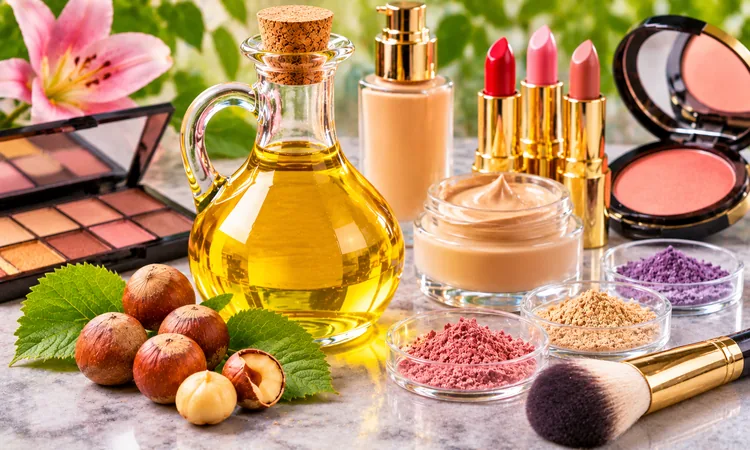
Overview. Color cosmetic formulations combine pigments, oils, waxes, emulsifiers and other functional materials to achieve the desired appearance, texture and application performance. Refined hazelnut oil may be evaluated as a plant-derived emollient ingredient in selected makeup bases where oil-phase compatibility, spreading behavior and sensory properties are important.
The Role of Refined Hazelnut Oil in Color Cosmetics
Oils are important components of many color cosmetic systems, contributing to the movement and distribution of other ingredients during processing and application.
Refined hazelnut oil contains predominantly unsaturated fatty acids, particularly oleic acid, and may be investigated as a liquid botanical lipid ingredient in compatible makeup formulations.
Its possible contributions include oil-phase lubrication, spreading and modification of the formulation's sensory characteristics.
Performance depends on the full ingredient system, including pigments, dispersants, waxes, film-forming materials and processing conditions.
Potential Applications in Makeup Formulation
Refined hazelnut oil may be evaluated in selected cosmetic color formulations where a liquid emollient component is appropriate.
- Liquid foundation bases: Investigation as part of the oil phase in compatible emulsion or anhydrous systems.
- Cream makeup formulations: Evaluation for spreading and sensory behavior in pigment-containing semisolid products.
- Concealer formulations: Assessment of oil-phase compatibility with pigments, structuring agents and other ingredients.
- Lip color prototypes: Investigation in selected wax-and-oil systems where application texture and ingredient compatibility are relevant.
Each application requires formulation-specific stability and safety assessment. No universal compatibility with cosmetic pigments or waxes is implied.
Pigment Wetting and Dispersion
Uniform pigment distribution is essential for consistent color appearance and makeup performance.
Pigment wetting describes the interaction between the liquid phase and pigment particle surfaces. Dispersion processing aims to distribute pigment particles consistently within the formulation.
Refined hazelnut oil may be investigated as part of a pigment-containing oil phase, but its suitability depends on the pigment type, surface treatment, dispersant system and processing conditions.
Important evaluations include:
- Pigment wetting and dispersion uniformity.
- Agglomeration and particle distribution.
- Color consistency between batches.
- Viscosity and flow behavior.
- Changes in color appearance during storage.
Proper dispersion should be verified using suitable analytical and application tests rather than assumed from the oil's general properties.
Emollient Performance and Makeup Texture
The choice of emollient influences the feel of a cosmetic formulation during application and after spreading.
Liquid oils may affect lubrication, slip, spreading, product payoff and the perception of richness or residual oiliness.
Relevant variables include:
- Oil concentration: The proportion of refined hazelnut oil within the total formulation.
- Viscosity: Flow characteristics during dispensing and application.
- Wax structure: Interactions between liquid oils and selected structuring materials.
- Pigment loading: The quantity and nature of colorants used in the formulation.
- Film formation: Compatibility with ingredients controlling adhesion, wear and application.
Any claims concerning long wear, improved coverage or enhanced skin appearance require appropriate finished-product substantiation.
Wax Structure and Anhydrous Makeup Bases
Some cosmetic color products use anhydrous oil-and-wax systems to achieve a particular consistency and application profile.
Liquid oils can influence the balance between hardness, flexibility, product payoff and thermal stability.
When investigating refined hazelnut oil in these systems, formulators should assess compatibility with the selected waxes and other structuring ingredients.
Changes to the oil phase may require adjustment of the complete wax-and-oil formulation.
Industrial Mixing and Manufacturing Considerations
Color cosmetic manufacturing may involve controlled pigment dispersion, blending, emulsification, homogenization or heating and cooling, depending on the product type.
Important process controls include:
- Ingredient addition sequence and weighing accuracy.
- Pigment dispersion equipment and mixing intensity.
- Temperature exposure during processing.
- Product viscosity and batch uniformity.
- Equipment hygiene and prevention of cross-contamination.
- Filling conditions and packaging compatibility.
Pilot batches should be compared under consistent processing conditions to evaluate the specific influence of refined hazelnut oil.
Stability and Quality Testing
The quality of color cosmetics must be maintained throughout manufacturing, storage and intended use.
Formulation trials may include the following evaluations:
- Physical appearance and product uniformity.
- Pigment dispersion and color consistency.
- Viscosity, texture and application behavior.
- Emulsion stability or oil separation, where applicable.
- Heat and temperature-cycle stability.
- Oxidation indicators and changes in odor.
- Microbiological quality and preservative effectiveness for relevant systems.
- Packaging compatibility and performance during storage.
The testing program should reflect the intended cosmetic category and destination-market requirements.
Refined Hazelnut Oil Technical Specifications
Consistent ingredient quality supports controlled formulation development and industrial production.
The stated specifications of the supplied refined hazelnut oil include:
| Quality Parameter | Stated Value |
|---|---|
| Free Fatty Acids (FFA) | Maximum 0.3% |
| Moisture Content | Maximum 0.2% |
| Oleic Acid | 74.2–86.7% |
These values represent stated raw-material acceptance parameters rather than guaranteed cosmetic performance or finished-product safety.
Cosmetic developers may require additional information concerning identity, purity, oxidation, microbiological quality, potential contaminants and batch consistency.
Review the refined hazelnut oil technical specifications and confirm current documentation before procurement.
INCI Identification and Cosmetic Labeling
Hazelnut seed oil is generally identified in cosmetic ingredient nomenclature as Corylus Avellana (Hazel) Seed Oil.
The final INCI declaration should be verified against the identity of the purchased ingredient and the applicable destination-market requirements.
Cosmetic manufacturers must ensure that permitted colorants, ingredient labeling, safety documentation and promotional claims comply with the regulations governing their finished products.
For European Union cosmetic products, relevant obligations include those established under Regulation (EC) No 1223/2009.
Safety and Sensitization Considerations
Hazelnut is a tree nut, and possible sensitization concerns should be considered in the safety assessment of the finished cosmetic formulation.
The refining process alone should not be used to assume that every potential sensitivity concern has been eliminated.
Product developers should evaluate intended exposure, ingredient concentrations, the application area and appropriate safety evidence before commercial launch.
No claims of hypoallergenic performance, clinical efficacy or medical treatment are made for the supplied refined hazelnut oil.
Recommended Cosmetic Formulation Trials
Manufacturers should begin with a reference makeup formulation and introduce controlled changes to the oil phase.
Relevant trial variables include refined hazelnut oil concentration, pigment dispersion conditions and interactions with structuring materials.
The resulting formulations should be assessed for appearance, texture, application, color consistency and storage stability.
Commercial adoption should follow suitable safety, stability and regulatory qualification.
Bulk Refined Hazelnut Oil for Cosmetic Manufacturers
Atlas Global Trading supplies refined hazelnut oil for international industrial and wholesale buyers.
Cosmetic manufacturers and formulation developers may enquire about current product specifications, available documentation and commercial packaging options.
Available commercial formats include:
- 30 kg plastic drums: A smaller industrial purchasing format.
- 60 kg plastic drums: An intermediate bulk supply option.
- 200 kg plastic drums: Suitable for larger-volume industrial ingredient requirements.
- Larger export and tanker formats: Considered according to commercial volume and logistics feasibility.
Packaging availability does not independently establish cosmetic-grade certification or suitability for a particular finished product.
Commercial Purchasing and Quality Documentation
Ingredient procurement should be coordinated with formulation, quality and regulatory teams before placing an industrial order.
Buyers should identify their intended application, required material grade, quantity, packaging preference, destination country and available documentation needs.
Commercial discussions may also cover batch traceability, current specifications, shipping requirements, expected delivery arrangements and applicable trade terms.
The cosmetic manufacturer remains responsible for finished-product safety, claims substantiation and regulatory compliance.
Why Contact Atlas Global Trading?
Atlas Global Trading focuses on international bulk refined hazelnut oil supply for professional industrial and wholesale ingredient buyers.
Our commercial approach emphasizes clear product information, practical packaging options and purchasing discussions based on customer requirements.
Share your expected purchasing quantity, packaging preference, delivery destination, cosmetic application and technical documentation requirements. Our team will review the inquiry and discuss available commercial options. Final formulation suitability, safety and cosmetic regulatory compliance remain the manufacturer's responsibility.