
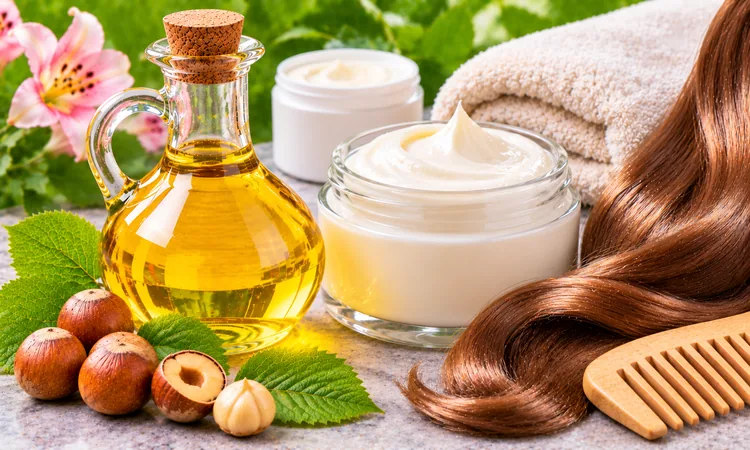
Overview. Hair masks and deep treatment creams commonly combine conditioning agents, emollients, emulsifiers and structuring ingredients to deliver a rich texture and controlled application. Refined hazelnut oil may be evaluated as a botanical emollient within compatible oil phases. Successful development requires appropriate emulsion design, processing controls, stability testing and finished-product safety evaluation.
The Role of Refined Hazelnut Oil in Hair Mask Formulation
Many hair masks are oil-in-water emulsions containing fatty alcohols, conditioning agents, emulsifiers and selected emollient oils. Each component contributes to texture, hair deposition, sensory performance and stability.
Refined hazelnut oil has a predominantly unsaturated fatty acid composition, including a substantial proportion of oleic acid. It may be investigated as part of the liquid lipid fraction of selected conditioning cream formulations.
The oil does not independently provide the same function as a cationic conditioning agent or structured emulsifier system. Its contribution must be assessed within the complete formulation.
Potential Hair Mask and Treatment Cream Applications
Cosmetic manufacturers may evaluate refined hazelnut oil in different types of hair treatment products:
- Rinse-off hair masks: Investigation of cream distribution, wet combing, rinseability and after-rinse sensory properties.
- Rich conditioning creams: Evaluation as an additional emollient within a structured conditioning emulsion.
- Professional salon treatment creams: Testing of dispensing behavior, application consistency and product stability.
- Botanical emollient formulations: Assessment alongside other compatible cosmetic lipids and conditioning ingredients.
Application suitability depends on whether the product is rinse-off or leave-on, the targeted hair type and the full formulation.
Conditioning Emulsions and Oil-Phase Compatibility
The stability of a hair mask depends on the interactions among its oil phase, aqueous phase, emulsifiers, conditioning agents and thickeners. Many conditioning systems use cationic surfactants and fatty alcohol structures.
Introducing refined hazelnut oil may affect droplet formation, cream consistency and the distribution of emollient material. Formulators should evaluate ingredient compatibility before increasing the concentration of liquid oil.
Important variables include emulsion droplet distribution, oil-phase loading, mixing intensity, temperature and the balance between emulsifiers and structuring ingredients.
Texture, Viscosity and Hair Application
Deep treatment creams generally require enough viscosity to maintain a consistent appearance and provide controlled dispensing and application. However, excessive thickness can make products difficult to distribute through the hair.
The level of refined hazelnut oil may influence the final cream's rheology and sensory behavior. Manufacturers should assess:
- Viscosity and flow at relevant processing temperatures.
- Product consistency after cooling and storage.
- Ease of distribution through wet hair.
- Perceived richness, lubrication and residual oiliness.
- Rinseability and any undesirable heavy residue.
Sensory performance should be evaluated with standardized application quantities and appropriate reference formulations.
Wet Combing, Rinseability and Conditioning Claims
Hair treatment performance cannot be determined solely from the fatty acid composition of an oil. Conditioning results depend on how the complete formula interacts with the hair surface.
Manufacturers may use controlled hair-tress testing to assess wet or dry combing, detangling, surface feel and other relevant cosmetic performance attributes.
For rinse-off masks, the amount of material remaining after rinsing is an important formulation consideration. Claims concerning improved combability, reduced frizz or visible conditioning should be supported by suitable finished-product evidence.
Industrial Manufacturing and Emulsification
Commercial production typically requires controlled oil-phase and aqueous-phase preparation, followed by emulsification, mixing and cooling under appropriate process conditions.
Relevant manufacturing controls include:
- Accurate weighing and raw-material verification.
- Oil and water phase preparation and addition sequence.
- Temperature and mixing-speed control.
- Homogenization and emulsion uniformity.
- Cooling profile and viscosity development.
- Hygienic handling and microbiological control.
- Batch traceability and packaging-line consistency.
Pilot-scale results should be validated at commercial scale because different equipment and batch volumes can influence droplet size and final viscosity.
Stability, Preservation and Quality Testing
Hair masks containing water require an appropriate preservation strategy and microbiological quality controls. The presence of refined hazelnut oil does not replace the need for preservation.
A product development program should consider the following assessments:
- Viscosity, pH and visual uniformity.
- Emulsion stability and phase separation.
- Elevated-temperature and temperature-cycle stability.
- Odor, color and appropriate oxidation indicators.
- Microbiological quality and preservative effectiveness.
- Packaging compatibility and dispensing performance.
- Hair-tress evaluation for relevant conditioning claims.
Accelerated testing can assist development, but finished-product shelf life must be justified using an appropriate stability program and the actual commercial packaging.
Refined Hazelnut Oil Technical Specifications
Raw-material specifications should be reviewed as part of incoming ingredient qualification. The stated refined hazelnut oil quality values are:
| Quality Parameter | Stated Value |
|---|---|
| Free Fatty Acids (FFA) | Maximum 0.3% |
| Moisture Content | Maximum 0.2% |
| Oleic Acid | 74.2–86.7% |
These are stated raw-material acceptance values. They do not establish cosmetic-grade certification, emulsion compatibility, guaranteed conditioning performance or finished-product safety.
Additional documentation or testing may be necessary for identity, oxidation, contaminants and batch-to-batch consistency.
Consult the refined hazelnut oil technical specifications and confirm current available product documents.
INCI Identification, Safety and Cosmetic Compliance
Hazelnut seed oil is generally listed in cosmetic ingredient nomenclature as Corylus Avellana (Hazel) Seed Oil. The appropriate INCI designation should be verified against the supplied ingredient documentation.
Hazelnut is a tree nut. Potential sensitization concerns should be assessed in relation to the finished formulation, exposure and intended consumer use. Refining alone does not prove the absence of all sensitivity risks.
Cosmetic manufacturers are responsible for product safety assessment, ingredient labeling, claims substantiation and the applicable requirements of their destination markets.
For products placed on the European Union market, relevant requirements include Regulation (EC) No 1223/2009. No medical, therapeutic or guaranteed hair-repair claims are made for the supplied refined hazelnut oil.
Recommended Formulation Development Trials
Manufacturers should begin with an established reference cream and evaluate controlled changes to the emollient phase. Trial batches may compare selected refined hazelnut oil concentrations, emulsifier compatibility and processing conditions.
Results should be assessed through viscosity, emulsion stability, hair-tress performance, rinseability, sensory characteristics and packaging tests. Commercial-scale use should follow appropriate quality and safety validation.
Bulk Refined Hazelnut Oil for Hair Care Manufacturers
Atlas Global Trading supplies refined hazelnut oil to international industrial and wholesale ingredient buyers. Cosmetic manufacturers developing hair masks and deep treatment creams may enquire about current specifications, documentation and bulk packaging options.
Commercial supply formats include:
- 30 kg plastic drums: Smaller industrial purchasing format.
- 60 kg plastic drums: Intermediate bulk supply option.
- 200 kg plastic drums: Larger-volume ingredient purchasing.
- Larger export and tanker formats: Subject to order volume and logistics feasibility.
Atlas Global Trading supplies refined hazelnut oil as a raw material, not finished hair masks, conditioning creams or retail cosmetic products.
Commercial Procurement and Documentation
Ingredient purchasing teams should confirm the intended cosmetic application, required material grade, forecast consumption, preferred packaging and destination.
Commercial discussions may cover current product specifications, available batch documentation, shipment arrangements, receiving requirements and trade terms. Final raw-material acceptance and formulation suitability remain the buyer's responsibility.
Send your expected purchasing quantity, preferred packaging, delivery destination, hair care application and technical documentation requirements. Our team will review the inquiry and discuss available commercial supply options.