
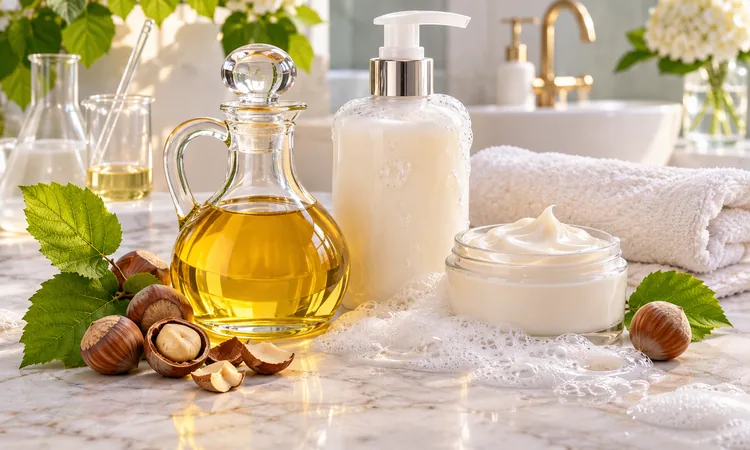
Technical and Commercial Overview
Creamy body wash formulations combine cleansing ingredients with components designed to produce a particular texture, appearance, application experience and rinse-off performance.
Certain formulations incorporate an emollient oil phase within a surfactant system. Refined hazelnut oil may be evaluated as one potential ingredient for this purpose.
Introducing vegetable oil into a body wash is not a simple substitution. Oil can influence surfactant organization, emulsion stability, viscosity, foam volume, lather structure and the sensory characteristics of the finished cleanser.
The formulation must also meet appropriate microbiological safety, preservation, skin compatibility, packaging and regulatory requirements.
This guide examines the technical considerations for incorporating refined hazelnut oil into creamy body wash products and the commercial information relevant to cosmetic ingredient buyers.
1. Refined Hazelnut Oil in Creamy Body Wash Applications
Body wash products may be developed as transparent gels, opaque creams, liquid emulsions or other rinse-off cleansing systems.
These product types can vary considerably in surfactant content, oil-phase design, viscosity and intended sensory properties.
Creamy Shower Cleansers
Opaque, cream-like body washes may contain cleansing surfactants and compatible emollient ingredients. Refined hazelnut oil can be considered for evaluation within the oil phase.
Emollient-Enriched Body Washes
Some rinse-off formulations include lipids to modify the application experience. Actual deposition, after-feel and skin performance depend on the complete product.
Creamy Shower Gel Systems
A surfactant-based gel may be modified with compatible ingredients to produce an opaque or creamier appearance, but the formula may require changes to its thickening system.
Professional Personal-Care Products
Industrial formulators may investigate refined hazelnut oil in selected professional body-cleansing formulations, subject to raw material approval and finished-product testing.
Role of the Emollient Oil Phase
Emollient ingredients may influence spreading, lubrication, texture and perceived after-feel.
In a rinse-off product, however, the delivered sensory effect depends on how the oil interacts with the surfactant system, skin surface and rinsing process.
The presence of refined hazelnut oil does not independently establish moisturizing, skin-barrier, sensitive-skin or other cosmetic performance claims.
Setting Product Development Objectives
- Developing a creamy or opaque body wash appearance.
- Evaluating the inclusion of a vegetable oil phase.
- Modifying cleansing and rinsing sensory characteristics.
- Maintaining suitable foam volume and stability.
- Adjusting viscosity and dispensing behavior.
- Maintaining emulsion stability during storage.
- Establishing an appropriate preservative system.
- Meeting raw material and finished-product safety requirements.
These are formulation goals that should be assessed experimentally, not guaranteed outcomes from adding the oil.
2. Technical Properties of Refined Hazelnut Oil
Refined hazelnut oil is a liquid vegetable oil characterized by its fatty-acid profile and selected physicochemical properties.
These characteristics may be relevant to cosmetic raw material identification, incoming quality control and formulation development.
| Parameter | Published specification | Cosmetic formulation relevance |
|---|---|---|
| Composition | 100% refined hazelnut oil | Ingredient identity and qualification. |
| Oleic acid | 74.2–86.7% | Dominant monounsaturated fatty acid. |
| Linoleic acid | 5.2–18.7% | Polyunsaturated fatty-acid component. |
| Palmitic acid | 4.2–8.9% | Part of the saturated fatty-acid fraction. |
| Stearic acid | 0.8–3.2% | Additional saturated fatty-acid component. |
| Free fatty acids | Maximum 0.3% | Indicator related to refining quality and oil condition. |
| Moisture | Maximum 0.2% | Relevant to incoming oil storage and handling. |
| Peroxide value | Maximum 10 meq/kg | Indicator of primary lipid oxidation. |
| Density at 20°C | 0.898–0.915 g/mL | Physical characterization and mass-volume calculations. |
| Iodine value | 81–92 | Characterization of oil unsaturation. |
| Saponification value | 188–198 mg KOH/g | Additional raw material characterization. |
| Refractive index at 20°C | 1.468–1.473 | Supports physical identity assessment. |
| Insoluble impurities | Maximum 0.05% (m/m) | Relevant to ingredient cleanliness. |
High Oleic Acid Composition
Oleic acid represents the dominant fatty-acid fraction in the published specification.
The composition may be relevant when assessing the liquid oil phase, but it does not establish finished-product cleansing, skin compatibility or emollient performance.
Oxidation and Raw Material Quality
Vegetable oils containing unsaturated fatty acids can oxidize under unfavorable storage and processing conditions.
Oxidation may affect odor, appearance and product quality. Manufacturers should establish suitable raw material limits and monitor the finished formulation.
Oil Versus Finished Body Wash Properties
The published oil density, chemical parameters and fatty-acid composition describe the raw ingredient.
They do not specify the pH, viscosity, foam performance or preservation properties of a body wash containing refined hazelnut oil.
3. Surfactant Compatibility and Oil Incorporation
Body washes commonly rely on surfactants to provide cleansing and support the dispersion of hydrophobic materials during washing.
The addition of refined hazelnut oil changes the formulation environment and may affect surfactant interactions.
Primary Cleansing Surfactants
The primary surfactant system influences cleansing, foam characteristics, formulation viscosity and skin-use properties.
The effects of incorporating an oil phase depend on surfactant identity, concentration and other formulation components.
Co-Surfactants and Compatibility
Co-surfactants may be used to modify foam, viscosity or formulation behavior.
Adding oil may change these relationships, requiring changes to the surfactant blend or the supporting stabilization system.
Solubilization Versus Emulsification
Low concentrations of certain hydrophobic materials may be incorporated through an appropriately designed solubilization system.
Higher or differently structured oil phases may require a separate emulsion stabilization strategy.
Manufacturers must distinguish between a visually clear or solubilized system and an opaque emulsion containing dispersed oil droplets.
Effect of Oil Concentration
The amount of oil incorporated may influence the balance between cleansing performance, foam, dispersion and viscosity.
There is no universal refined hazelnut oil concentration suitable for every creamy body wash formula.
4. Emulsion Design and Phase Stability
A creamy body wash may contain dispersed oil droplets within a water-rich cleansing system.
Suitable formulation and processing are required to maintain the desired appearance and physical structure.
Oil-in-Water Emulsions
Refined hazelnut oil may be evaluated within the dispersed oil phase of an appropriately designed oil-in-water system.
Surfactant-Structured Cream Cleansers
Some cream cleansers rely on a combination of surfactants, structured ingredients and emollients to create their intended texture.
Stabilized Oil Droplets
The dispersed oil may require compatible emulsifiers and appropriate droplet size distribution to achieve suitable physical stability.
Opaque Surfactant Systems
An opaque appearance does not necessarily mean the product contains a stable emollient oil emulsion. Product structure must be assessed directly.
Oil Droplet Size
The dispersed oil droplet size and distribution can influence appearance, physical stability and sensory behavior.
Droplet size is influenced by the formulation, mixing equipment and processing conditions.
Emulsion Separation
Potential instability may include droplet coalescence, creaming, visible oil separation or changes in consistency.
A formulation that appears uniform immediately after mixing may change during storage.
Temperature Sensitivity
Storage and processing temperatures may influence the stability of a body wash emulsion.
Manufacturers should evaluate physical stability under relevant temperature conditions and after temperature cycling.
5. Foam Performance, Lather Quality and Cleansing
Foam behavior is an important sensory and functional characteristic of many body wash products.
Adding vegetable oil can affect how the surfactant system generates and maintains foam.
Foam Volume
The oil phase may influence foam generation depending on the amount of oil and the surfactant system.
A reduction or change in foam should not automatically be interpreted as a reduction in cleansing effectiveness.
Both characteristics require appropriate product-specific testing.
Foam Stability
Foam stability can be affected by surfactants, formulation additives, water conditions and oil content.
Manufacturers may compare foam persistence and bubble structure under controlled testing conditions.
Foam Texture
Consumer perception may be affected by foam density, bubble size, spreading and rinsing characteristics.
These sensory characteristics depend on the complete formulation and method of use.
Suggested Foam Evaluation
- Initial foam generation under a defined test method.
- Foam volume and stability.
- Foam characteristics under different water conditions.
- Effect of the selected oil concentration.
- Foam behavior during dilution and rinsing.
- Product-specific cleansing performance.
- Consumer-relevant sensory observations.
6. Viscosity, Rheology and Dispenser Performance
Viscosity affects the way a body wash is pumped, filled, dispensed and applied.
Many surfactant-containing cosmetic formulations show complex flow behavior.
Adding an oil phase can modify the structure responsible for the product's viscosity.
Surfactant Thickening Systems
Certain surfactant blends respond to electrolytes or other thickening ingredients.
Their response may change after adding an oil phase.
A thickening system optimized for a clear cleanser may not perform identically in a creamy, oil-containing formulation.
Emulsion-Related Viscosity
Dispersed oil droplets and stabilizing ingredients can influence the overall rheology of the body wash.
The actual outcome depends on the formulation and droplet structure.
Shear Behavior
Some products change apparent viscosity when subjected to different shear rates.
Manufacturers should measure viscosity under defined and reproducible test conditions.
Packaging and Pump Compatibility
The finished formulation should be evaluated with its intended packaging system.
Relevant considerations include pump dispensing, squeeze-bottle flow, leakage, product residue and consumer handling.
Suggested Rheology and Dispensing Tests
- Viscosity at defined temperatures and shear conditions.
- Viscosity changes after storage.
- Flow recovery or time-dependent behavior where relevant.
- Effect of changing oil concentration.
- Dispensing through the final pump or closure.
- Performance during filling and transfer.
- Product appearance after repeated use.
7. Skin Feel, Rinse-Off Performance and Emollient Evaluation
Consumer acceptance of creamy body washes depends on the complete washing experience.
Texture during dispensing, spreading, lathering and rinsing may all influence product perception.
Emollient Phase Contribution
Vegetable oils may contribute to the formulation's sensory profile.
In a rinse-off system, the amount and nature of any material remaining after rinsing depend on the complete formulation.
After-Feel
Manufacturers may assess perceived softness, residue, smoothness and skin feel after cleansing.
These characteristics should be evaluated under controlled use conditions and supported by appropriate testing.
Rinsing Behavior
Oil-phase design and surfactant compatibility can influence how the formula disperses during rinsing.
An excessive residual feel or incomplete rinsing may be unacceptable for some target products.
Claims Substantiation
Claims such as moisturizing, gentle, suitable for sensitive skin or improved skin comfort require appropriate evidence for the finished cosmetic product.
These claims cannot be inferred solely from the inclusion of refined hazelnut oil.
8. Preservation, Microbiological Safety and pH Control
Many creamy body washes contain substantial quantities of water and therefore require appropriate microbiological risk management.
The presence of refined hazelnut oil does not eliminate the need for a suitable preservation strategy.
Preservative System Selection
Preservative performance depends on the selected ingredients, their concentrations, formulation pH, packaging and foreseeable use.
An oil phase may influence the distribution or availability of some formulation ingredients, including preservatives.
Compatibility should be confirmed in the finished formula.
Preservative Efficacy Testing
Appropriate preservative efficacy or challenge testing may be needed to verify that the finished product meets its established microbiological safety objectives.
An appropriate testing protocol should be selected according to the product type, intended market and relevant cosmetic standards or regulations.
pH Control
The pH of a water-containing body wash can affect ingredient compatibility, surfactant performance, preservation and other formulation characteristics.
A suitable target pH must be established for the complete product and its intended use.
The raw refined hazelnut oil specification does not establish the pH of the finished cosmetic cleanser.
Manufacturing Hygiene
Water quality, equipment cleanliness, ingredient handling and filling conditions all influence microbiological risk.
The manufacturing facility should establish appropriate hygienic controls and microbiological acceptance criteria.
9. Industrial Manufacturing and Processing Considerations
Commercial body wash production requires consistent raw material handling, ingredient addition, mixing, temperature control and filling.
Refined hazelnut oil should be incorporated using a process compatible with the overall formulation.
Raw Material Receiving
Incoming oil should be checked against the approved raw material specification.
Receiving checks may include identification, documentation, package condition, appearance and selected analytical criteria.
Ingredient Addition Sequence
The appropriate addition sequence depends on the surfactants, emulsifiers, thickeners and other materials in the recipe.
Adding oil too quickly or under unsuitable conditions may affect dispersion or product stability.
Mixing and Shear
Mixing intensity can influence oil droplet distribution, foam incorporation and the final physical characteristics of the product.
Excessive aeration may complicate processing and filling in some formulations.
Temperature Management
Processing temperatures must be suitable for the specific ingredients and chosen manufacturing method.
Unnecessary prolonged exposure to heat should be avoided where it may affect ingredient quality.
Filling and Packaging
The final body wash should be evaluated with its selected bottle, tube, dispensing pump or other suitable container.
Packaging compatibility, closure integrity, dispensing and product protection require appropriate validation.
Suggested Formulation Development Sequence
- Define the product specification. Establish the intended texture, foam, cleansing, sensory and packaging requirements.
- Approve candidate raw materials. Review refined hazelnut oil and other ingredient specifications.
- Evaluate surfactant compatibility. Assess the proposed oil phase with the selected cleansing system.
- Develop a stable dispersion. Select appropriate emulsification, solubilization or structuring ingredients.
- Prepare controlled pilot batches. Record ingredient levels and process conditions.
- Assess foam and viscosity. Compare the experimental product with a suitable reference.
- Evaluate safety and preservation. Complete appropriate finished-product safety and microbiological assessments.
- Conduct stability testing. Review phase separation, appearance, oxidation and packaging performance.
- Validate commercial production. Confirm acceptable consistency before full-scale manufacture.
10. Cosmetic Safety, INCI Identification and Regulatory Requirements
Raw material identity and safety qualification are fundamental to cosmetic formulation development.
A body wash manufacturer must establish whether the complete product is safe and compliant for its intended market.
INCI Identification
Corylus Avellana Seed Oil is a commonly used INCI designation for hazelnut seed oil.
The cosmetic manufacturer should verify the correct INCI nomenclature, botanical identity and associated documentation for the supplied raw material.
Cosmetic Versus Food Ingredient Qualification
Refined hazelnut oil supplied for food manufacturing should not automatically be considered suitable for every cosmetic application.
Cosmetic producers should independently evaluate purity, safety, documentation, compatibility and applicable regulatory requirements.
Hazelnut-Related Sensitivity Considerations
Hazelnuts are tree nuts, and appropriate ingredient-related sensitivity considerations should be included in the cosmetic safety assessment.
Refining should not automatically be assumed to establish an allergen-free ingredient.
Skin Compatibility
Skin compatibility depends on the entire formulation, surfactant selection, preservation system, ingredient concentrations and intended consumer use.
A finished-product assessment is required before making relevant tolerance or skin-benefit claims.
Regulatory Documentation
The applicable requirements vary by destination market and cosmetic product category.
Depending on the market, manufacturers may need documented safety assessment, appropriate manufacturing practices, ingredient labeling, product information and substantiation of marketing claims.
11. Physical Stability, Oxidation and Packaging Compatibility
Creamy body wash formulations should maintain appropriate appearance, texture, chemical quality and microbiological safety over their intended shelf life.
Physical Stability
Potential instability may include oil separation, viscosity changes, color changes, sediment or other appearance defects.
Formulators should monitor these characteristics under appropriate storage conditions.
Centrifugation and Temperature Cycling
Centrifugation and controlled temperature cycling may be used as screening tools for certain physical stability concerns.
Such tests do not independently replace appropriate real-time finished-product stability evaluation.
Oxidative Stability
The oil phase may undergo oxidation during storage, depending on the formulation and environmental exposure.
Appropriate testing may consider changes in odor, appearance and relevant chemical indicators.
Preservative Stability
Formulation changes, including the addition of vegetable oil, may influence preservative behavior.
Preservation performance should be assessed using the complete final formulation and appropriate testing procedures.
Packaging Stability
Product-contact packaging materials, pump components, closures and seals must be compatible with the actual body wash formulation.
Relevant checks include leakage, dispensing performance, appearance changes and product integrity after storage.
Raw Material Shelf Life Versus Body Wash Shelf Life
The supplied refined hazelnut oil product information states a 24-month shelf life under specified storage conditions.
This does not establish a 24-month shelf life for the finished body wash.
Finished-product shelf life and period-after-opening, where applicable, require independent assessment based on the final formula and packaging.
12. Quality Control and Pilot Testing Checklist
A structured testing program helps cosmetic manufacturers compare candidate formulas and assess whether refined hazelnut oil performs suitably within the intended system.
| Evaluation | Purpose | Relevant observations |
|---|---|---|
| Raw oil identity | Confirm the intended ingredient. | Specification and lot documentation. |
| Oil condition | Assess incoming material quality. | Appearance, odor and relevant analytical values. |
| Surfactant compatibility | Evaluate interaction with the oil phase. | Dispersion, appearance and formula changes. |
| Foam performance | Assess product lather characteristics. | Foam volume and stability under defined conditions. |
| Viscosity | Evaluate flow behavior. | Measurements at defined temperature and shear. |
| pH | Confirm finished-product control parameters. | Measured pH against the approved formulation specification. |
| Emulsion stability | Assess phase compatibility. | Creaming, coalescence or visible oil separation. |
| Temperature cycling | Evaluate physical changes. | Appearance, consistency and separation after cycling. |
| Microbiological quality | Assess product safety. | Appropriate microbiological acceptance testing. |
| Preservative efficacy | Verify preservation where applicable. | Appropriate challenge test results. |
| Sensory assessment | Evaluate consumer-use characteristics. | Texture, rinsability, after-feel and fragrance behavior. |
| Skin compatibility | Support cosmetic safety and claims. | Product-specific safety and tolerance assessment. |
| Oxidative stability | Assess oil-containing formula quality. | Appropriate chemical indicators and sensory changes. |
| Packaging compatibility | Verify container and pump suitability. | Leakage, dispensing and material interaction. |
| Shelf-life evaluation | Establish commercial storage performance. | Validated results under relevant conditions. |
Comparing Control and Experimental Batches
Product developers should document the existing formula and compare it with controlled refined hazelnut oil trials.
Mixing conditions, test methods and storage conditions should be consistent enough to support meaningful comparisons.
Production-Scale Verification
Laboratory results may differ from commercial production because of equipment geometry, mixing conditions, temperature management and filling procedures.
Manufacturers should confirm process consistency at the intended industrial scale.
13. Bulk Refined Hazelnut Oil Procurement for Body Wash Manufacturers
Atlas Global Trading focuses on the international bulk supply of 100% refined hazelnut oil.
Cosmetic and personal-care manufacturers evaluating the ingredient should specify the intended application and relevant qualification requirements when requesting a quotation.
Available Industrial Packaging for Inquiry
| Packaging | Published quantity | Commercial consideration |
|---|---|---|
| Plastic drum | 30 kg net | Smaller industrial units and controlled stock handling. |
| Plastic drum | 60 kg net | Intermediate manufacturing requirements. |
| Plastic drum | 200 kg net | Larger production quantities with suitable handling equipment. |
| Export flexitank | Shipment-dependent | Containerized bulk liquid delivery for compatible routes and facilities. |
| Bulk road tanker | 20 tonnes and above | High-volume delivery requiring suitable receiving infrastructure. |
Packaging Selection
Drum packaging may provide flexibility for manufacturers needing separate handling units or controlled inventory.
Larger bulk transport formats may be considered where suitable storage, pumping and unloading facilities are available.
Buyers should evaluate freight, handling costs, receiving capabilities and storage requirements before selecting the format.
Cosmetic Raw Material Documentation
Depending on the manufacturer's requirements, relevant documentation may include a current product specification, available lot-specific analytical results, fatty-acid information and supporting raw material identification details.
Any required cosmetic ingredient records, impurity limits, allergen information or additional testing should be discussed before order confirmation.
A product specification alone does not establish that every cosmetic regulatory requirement has been met.
International Shipping
International buyers should identify their destination country, port or delivery location and applicable customs or import documentation requirements.
Delivery terms, freight, shipment timing and documentation depend on the specific transaction.
Information to Include in Your Wholesale Inquiry
- Product: 100% refined hazelnut oil.
- Intended application: body wash cream or related personal-care formulation.
- Required net quantity in kilograms or metric tonnes.
- Preferred packaging format.
- Destination country and delivery location.
- Required quality criteria and impurity limits.
- Cosmetic ingredient documentation requirements.
- Expected shipment or delivery period.
- Receiving and storage facility requirements.
- One-time or recurring purchasing needs.
Explore the bulk packaging page and international export and logistics information for additional purchasing guidance.
14. Key Technical and Commercial Considerations
- Refined hazelnut oil may be evaluated as an oil-phase ingredient in suitable creamy body wash formulations.
- Surfactant compatibility must be assessed before adding the oil to an existing cleanser formula.
- Foam generation, foam stability and cleansing characteristics depend on the complete product.
- Emulsion stability requires appropriate formulation and processing conditions.
- Viscosity and dispenser performance may change when an oil phase is incorporated.
- Skin feel and cosmetic benefit claims require appropriate finished-product evidence.
- Preservation, microbiological safety and pH must be assessed for the final formulation.
- Oxidation, packaging compatibility and shelf life require suitable testing.
- Food-grade material should not automatically be assumed to meet all cosmetic ingredient requirements.
- Wholesale procurement requires agreement on specifications, packaging, quantity, documentation and delivery conditions.
Request Bulk Refined Hazelnut Oil for Body Wash Manufacturing
Developing creamy body washes, shower cleansers or other suitable personal-care formulations? Contact Atlas Global Trading with your intended application, required volume, packaging preference, destination and technical documentation needs.
Contact Our Sales TeamRelated Hair and Personal-Care Application Articles
This article provides general cosmetic formulation and commercial guidance. It does not establish cosmetic-grade certification, hypoallergenic status, medical effectiveness, validated body wash performance or finished-product safety. Manufacturers must independently qualify the ingredient, complete suitable safety and stability testing, assess preservation and verify applicable cosmetic regulations.