
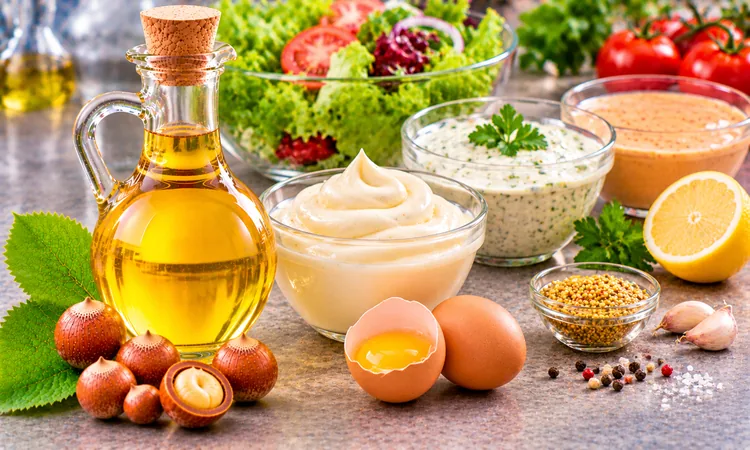
Overview. Mayonnaise and emulsified dressings are food systems in which small oil droplets are dispersed within a continuous aqueous phase. Refined hazelnut oil may be evaluated as a liquid oil ingredient in selected formulations. Stability depends on the emulsifier system, oil concentration, processing, acidification and finished-product testing.
Refined Hazelnut Oil in Mayonnaise Formulation
Mayonnaise-type products commonly combine edible oil, an aqueous acidic phase, emulsifying ingredients and seasonings. A stable emulsion is required to maintain the desired texture and appearance.
Refined hazelnut oil contains predominantly unsaturated fatty acids, particularly oleic acid, and may be considered as one oil-phase component in suitable mayonnaise and dressing formulations.
Its inclusion should be evaluated alongside the emulsifier system and target formulation properties. Direct replacement of another vegetable oil may change the product's sensory characteristics and stability.
Potential Mayonnaise and Dressing Applications
Manufacturers may investigate refined hazelnut oil in selected prepared-food formulations:
- Mayonnaise-type emulsions: Controlled evaluation of oil-phase composition, viscosity and physical stability.
- Creamy salad dressings: Investigation of oil dispersion, texture and flavor compatibility.
- Specialty emulsified sauces: Testing alongside suitable seasonings, acidifiers and emulsifying ingredients.
- Foodservice dressing formulations: Assessment of dispensing, storage and consistency under commercial conditions.
Product naming, ingredient composition and permitted formulations depend on applicable destination-market rules.
Oil-in-Water Emulsion Structure
Mayonnaise is commonly a concentrated oil-in-water emulsion. Its consistency depends on interactions between the dispersed oil droplets and the surrounding aqueous phase.
Droplet-size distribution, total oil content and emulsifier coverage influence viscosity and separation.
Changing the oil phase may affect droplet formation and the stability of the final emulsion.
Manufacturers should evaluate these effects using controlled laboratory and pilot-scale processing trials.
Egg Yolk and Alternative Emulsifier Systems
Traditional mayonnaise formulations often use egg yolk as an emulsifying ingredient. Other dressing systems may use suitable alternative emulsifiers or stabilizers.
The effectiveness of an emulsifier depends on its chemistry, concentration, the oil-to-water ratio and processing conditions.
Refined hazelnut oil should be assessed with the actual emulsifying system, including any starches, proteins or hydrocolloids used to control finished-product texture.
Oil Concentration and Viscosity Control
Oil concentration is an important formulation parameter because it influences droplet packing, viscosity and consistency.
Changes to the liquid oil fraction may alter the product's thickness, spreading and dispensing behavior.
Manufacturers should establish measurable target viscosity ranges under defined temperature and shear conditions.
Mixing, Homogenization and Droplet-Size Control
Industrial emulsion production requires suitable mixing, controlled ingredient addition and adequate dispersion of the oil phase.
Mixing intensity, oil addition rate, temperature and equipment configuration may affect droplet-size distribution.
Production teams should monitor mixing reproducibility and compare the resulting emulsion structure between batches.
Excessive or inappropriate processing may also cause undesirable changes in product consistency.
Acidification, pH and Microbiological Safety
Acidification is an important component of many mayonnaise and emulsified dressing food safety systems.
The required pH, acid composition, processing conditions and storage controls must be established for the specific recipe and destination market.
Adding refined hazelnut oil does not establish microbiological safety or replace a validated preservation and processing system.
Manufacturers should follow an appropriate food safety plan, including ingredient controls, equipment sanitation, microbiological testing and finished-product shelf-life validation.
Emulsion Stability and Oil Separation
Emulsified dressing systems may experience physical instability such as droplet aggregation, coalescence or visible oil separation.
The risk depends on oil-phase composition, emulsifier coverage, droplet size, acidity, viscosity and storage conditions.
Stability studies should monitor appearance, viscosity and separation throughout the intended product shelf life.
Oxidation Stability and Sensory Quality
Refined hazelnut oil contains unsaturated fatty acids that may oxidize under unfavorable storage conditions.
In emulsified products, oxidation can depend on oil quality, the interfacial environment, other ingredients, oxygen exposure and packaging.
Manufacturers may evaluate peroxide value, other suitable oxidation indicators, taste, odor and color during finished-product storage trials.
Recommended Production and Quality Tests
A practical formulation program should compare a reference product with controlled changes to the refined hazelnut oil fraction.
Relevant tests include:
- Droplet-size distribution and emulsion uniformity.
- Viscosity and rheological behavior.
- Physical stability and oil separation.
- pH and acidification consistency.
- Microbiological safety and preservation effectiveness.
- Flavor, odor and sensory stability.
- Oxidation indicators and storage stability.
- Packaging compatibility and shelf-life testing.
Laboratory results should be confirmed using representative production equipment, processing and distribution conditions.
Refined Hazelnut Oil Technical Specifications
Consistent incoming raw-material quality supports controlled emulsion production. The stated refined hazelnut oil quality parameters include:
| Quality Parameter | Stated Value |
|---|---|
| Free Fatty Acids (FFA) | Maximum 0.3% |
| Moisture Content | Maximum 0.2% |
| Oleic Acid | 74.2–86.7% |
These values describe stated raw-material acceptance parameters and do not guarantee emulsion stability, microbiological safety or finished-product shelf life.
Additional raw-material qualification may be required according to the manufacturer's purchasing specification and food safety program.
Review the refined hazelnut oil technical specifications and confirm current available batch documentation before procurement.
Food Safety and Allergen Management
Hazelnut is a tree nut and must be considered under applicable food allergen labeling requirements.
Mayonnaise formulations may also contain egg, mustard or other allergens depending on their ingredient composition.
Manufacturers should maintain appropriate ingredient declarations, cross-contact prevention procedures and destination-market regulatory compliance.
Bulk Refined Hazelnut Oil for Mayonnaise Manufacturers
Atlas Global Trading supplies refined hazelnut oil for international industrial and wholesale ingredient buyers, including manufacturers evaluating specialty oils for mayonnaise and emulsified dressing production.
Commercial packaging formats include:
- 30 kg plastic drums: Smaller industrial purchasing requirements.
- 60 kg plastic drums: Intermediate bulk ingredient orders.
- 200 kg plastic drums: Larger-volume industrial purchasing.
- Larger export and tanker formats: Subject to commercial volume and logistics feasibility.
Atlas Global Trading supplies refined hazelnut oil as a bulk raw material, not finished mayonnaise, dressings or ready-to-use sauces.
Commercial Purchasing and Supply Planning
Industrial procurement teams should confirm their intended formulation, required oil grade, purchasing volume, packaging preference, destination and receiving requirements.
Commercial discussions may include current specifications, available batch documentation, packaging, shipment planning, storage arrangements and applicable international trade terms.
Buyers remain responsible for finished-product qualification, labeling, food safety and regulatory compliance.
Share your expected order volume, preferred packaging, delivery destination, mayonnaise or dressing application and technical documentation requirements. Our team will review your inquiry and discuss available supply options.