
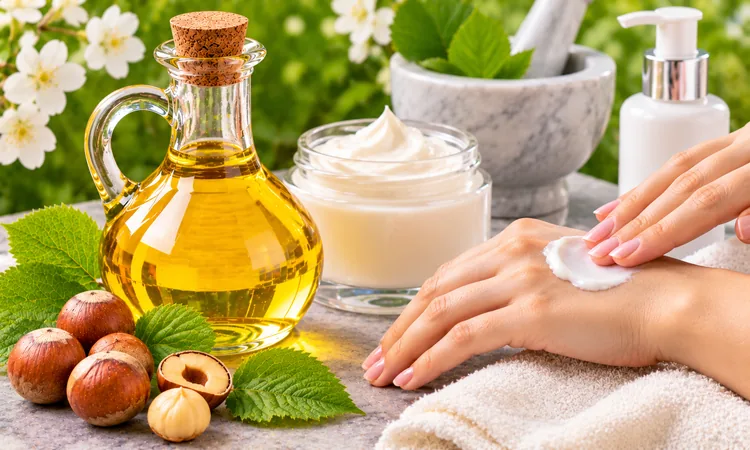
Overview. Hand creams are formulated to provide specific sensory and skin-conditioning characteristics through combinations of emollients, humectants, emulsifiers and other functional ingredients. Refined hazelnut oil may be investigated as a plant-derived emollient ingredient in selected hand cream formulations, subject to appropriate compatibility, stability and cosmetic safety testing.
Refined Hazelnut Oil in Hand Cream Formulations
Hand cream products commonly incorporate an oil phase to influence lubrication, spreading, sensory properties and overall formulation structure.
Refined hazelnut oil contains predominantly unsaturated fatty acids, particularly oleic acid, and may be considered during formulation trials involving botanical emollient ingredients.
The oil's contribution depends on its concentration, interactions with other ingredients and the processing conditions used to manufacture the finished cream.
Ingredient composition alone does not establish cosmetic efficacy, skin compatibility or suitability for all users.
Potential Hand Cream Product Applications
Refined hazelnut oil may be evaluated in selected hand cream and lotion systems where a liquid emollient is appropriate.
- Daily hand creams: Evaluation of spreading, rub-in behavior and the finished product's sensory characteristics.
- Rich hand cream formulations: Investigation as part of a multi-emollient oil phase alongside suitable structuring ingredients.
- Light hand lotions: Assessment of oil concentration and emulsion structure where a lower-viscosity formulation is required.
- Botanical emollient blends: Comparison with other compatible cosmetic lipids during product development.
Each formulation requires its own stability, safety and performance assessment.
Emollients, Humectants and Formulation Balance
Hand creams generally combine ingredients performing different functions.
Emollients influence skin feel and lubrication, while humectants help manage water-related properties within the formulation and its intended cosmetic function.
Emulsifiers are used to stabilize mixtures of oil and water phases in emulsion-based creams.
Refined hazelnut oil may form part of the emollient system, but its suitability depends on the complete ingredient combination.
Developers should evaluate whether changes to the oil phase influence cream viscosity, application characteristics or physical stability.
Hand Cream Texture and Sensory Properties
Consumer acceptance of hand creams is influenced by properties such as spreading, rub-in time, residual greasiness and overall skin feel.
The level of liquid oil in a cream may influence these characteristics.
Important formulation considerations include:
- Emollient concentration: The amount of refined hazelnut oil incorporated into the oil phase.
- Spreadability: The ease with which the cream moves across the skin surface.
- Rub-in behavior: Changes in perceived texture during application.
- Residual feel: Evaluation of greasiness, lubrication and sensory properties after application.
- Viscosity: The relationship between flow behavior and consumer dispensing experience.
Sensory evaluation should use appropriate protocols and compare experimental formulations against a suitable reference.
Oil-in-Water Emulsions and Cream Stability
Many hand creams use oil-in-water emulsion systems in which oil droplets are dispersed within a continuous aqueous phase.
Stable formulation requires a compatible emulsifier system and appropriate control of processing conditions.
The introduction of refined hazelnut oil may influence droplet formation, viscosity and phase stability.
Relevant tests may include:
- Emulsion droplet distribution and physical appearance.
- Viscosity and rheological behavior.
- Phase separation and creaming behavior.
- pH measurement where applicable.
- Temperature stability under appropriate test conditions.
- Packaging and dispensing compatibility.
The appropriate testing program depends on the specific formulation and intended market.
Industrial Hand Cream Manufacturing Process
Industrial cream manufacturing may involve separate preparation of oil and aqueous phases, controlled heating, emulsification, homogenization and cooling.
Important process controls include:
- Accurate ingredient weighing and batch documentation.
- Appropriate oil and water phase preparation.
- Temperature and mixing intensity control.
- Homogenization and emulsion consistency.
- Controlled cooling and addition of temperature-sensitive ingredients where required.
- Hygiene, microbiological management and filling conditions.
Commercial-scale validation should confirm that the intended cream properties remain consistent when batch size increases.
Preservation and Microbiological Quality
Water-containing hand cream formulations require appropriate microbiological risk management.
Depending on the formulation, preservative effectiveness testing may be necessary to support product safety throughout intended use.
The use of refined hazelnut oil does not eliminate the need for suitable preservation, hygienic manufacturing or finished-product microbiological assessment.
Oxidation, Storage Stability and Packaging
Unsaturated vegetable oils may undergo oxidation when exposed to unfavorable conditions including excessive heat, oxygen or light.
Oxidative changes can affect the odor, color and quality of a finished cosmetic formulation.
Stability testing may include:
- Changes in odor and appearance.
- Viscosity and texture during storage.
- Physical emulsion stability.
- Oil oxidation indicators.
- Preservative effectiveness and microbiological quality.
- Compatibility with tubes, jars, pumps or other selected packaging.
Product shelf life should be established through testing of the complete finished cream rather than only the raw oil ingredient.
Refined Hazelnut Oil Technical Specifications
Ingredient specification review supports controlled formulation development and incoming raw-material qualification.
The stated quality parameters of the supplied refined hazelnut oil include:
| Quality Parameter | Stated Value |
|---|---|
| Free Fatty Acids (FFA) | Maximum 0.3% |
| Moisture Content | Maximum 0.2% |
| Oleic Acid | 74.2–86.7% |
These values are stated raw-material acceptance parameters and do not establish cosmetic-grade certification, skin compatibility or finished-product efficacy.
Manufacturers may require additional testing and documentation according to their quality requirements and intended cosmetic use.
Review the refined hazelnut oil technical specifications and confirm available current documentation before procurement.
INCI Identification and Cosmetic Labeling
Hazelnut seed oil is generally identified in cosmetic ingredient nomenclature as Corylus Avellana (Hazel) Seed Oil.
The exact ingredient designation should be verified against supplier information and destination-market labeling requirements.
Cosmetic manufacturers are responsible for ingredient declarations, safety documentation, claims substantiation and all applicable product regulatory requirements.
In the European Union, relevant cosmetic obligations include those established under Regulation (EC) No 1223/2009.
Safety and Sensitization Considerations
Hazelnut is a tree nut, and potential sensitization concerns should be evaluated during the finished-product cosmetic safety assessment.
The refining process alone does not establish suitability for all skin types or eliminate every possible sensitivity concern.
Any claims concerning sensitive skin, dermatological testing or hypoallergenic performance must be supported by appropriate evidence.
No clinical, therapeutic or medicinal efficacy is claimed for the supplied refined hazelnut oil.
Recommended Hand Cream Formulation Trials
Manufacturers should begin with a suitable reference hand cream formulation and introduce controlled changes to the oil phase.
Trial batches may compare different refined hazelnut oil concentrations and emulsifier combinations.
Evaluation should include spreadability, rub-in behavior, perceived greasiness, viscosity, emulsion stability and packaging compatibility.
Commercial adoption should follow appropriate stability, microbiological and cosmetic safety qualification.
Bulk Refined Hazelnut Oil for Cosmetic Manufacturers
Atlas Global Trading supplies refined hazelnut oil for international industrial and wholesale buyers, including cosmetic manufacturers evaluating botanical lipid ingredients.
Commercial packaging options include:
- 30 kg plastic drums: A smaller industrial purchasing format.
- 60 kg plastic drums: An intermediate bulk supply option.
- 200 kg plastic drums: Suitable for larger-volume industrial ingredient requirements.
- Larger export and tanker formats: Considered according to commercial volume, receiving arrangements and logistics feasibility.
These are commercial supply options and do not independently establish cosmetic-grade certification or finished-product suitability.
Commercial Purchasing and Documentation
Cosmetic ingredient procurement should be coordinated with formulation, quality and regulatory teams before ordering.
Buyers should confirm expected order volume, required material grade, packaging preference, destination and technical documentation needs.
Commercial discussions may include current specifications, available batch documentation, shipping arrangements, delivery planning and relevant trade terms.
The cosmetic manufacturer remains responsible for final ingredient qualification, product safety and regulatory compliance.
Why Source from Atlas Global Trading?
Atlas Global Trading focuses on international bulk refined hazelnut oil supply for professional industrial and wholesale customers.
Our commercial approach emphasizes clear product information, practical packaging formats and purchasing discussions based on customer requirements.
Share your required quantity, preferred packaging, delivery destination, intended hand cream application and technical documentation requirements. Our team will review the inquiry and discuss available commercial supply options. Final formulation suitability, cosmetic safety and regulatory compliance remain the manufacturer's responsibility.